





March 2019 "The New Technology Changing the Global Automotive Industry---Current and Future Status of the 'C.A.S.E.'---"
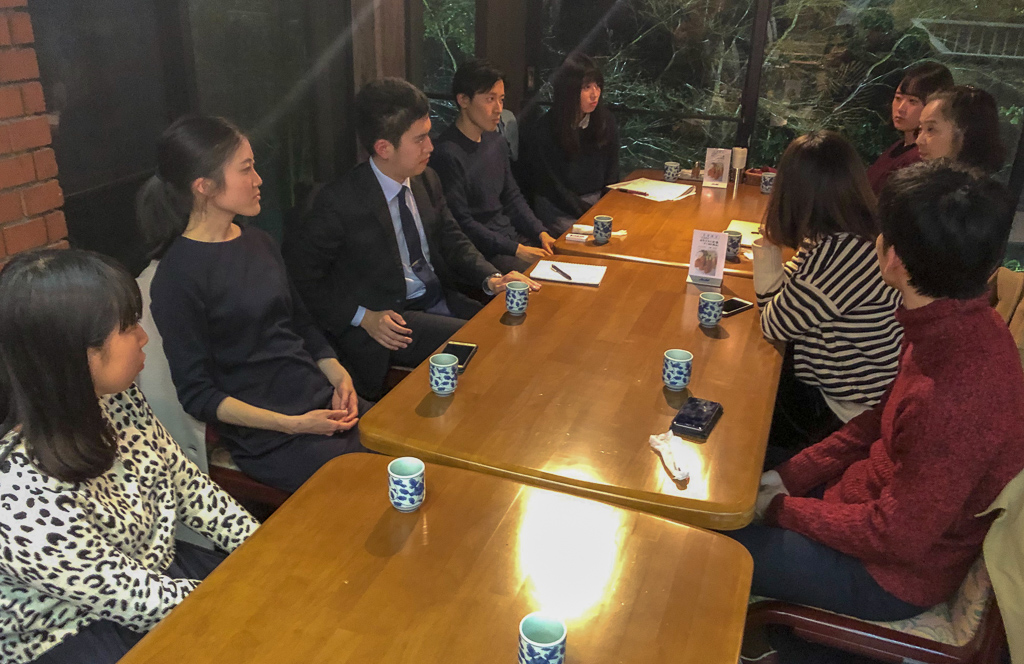
“Do you want to drive a car in the future?” Mr. Nakatsuru asked us at the beginning of the Alumni Talk. We, while having dinner, talked casually about the current situations regarding the automobile industry based on his handout. It indicated four major trends that are changing the automotive industry. The acronym “C.A.S.E.” (“Connected”, “Autonomous”, “Shared & Services”, “Electric”) is regarded as key elements in “the changes for the next 100 years.” We discussed a variety of topics, such as electric vehicles, autonomous cars, and the relationship between cars and rural areas in Japan. Here, I would like to review one of the discussions as an example.
We considered whether the demands for the new technologies would, in fact, increase or not. One student insisted that we might not expect an increase. He stated that over a long period of time, the demand in developing regions like Africa, ASEAN, and India, would increase. These areas may pay attention to price or to the number of vehicles sold, and may not appreciate the new technologies. Mr. Nakatsuru made a comment that the demand in developing regions would increase, but it would probably take 30-50 years, given that the EV tech and autonomous driving system will develop dramatically in the next 5-10 years, he assumed the markets of US, EU, and China were still important for almost all of the automobile companies.
This answer based on his belief that, in any business situation, the case should be analyzed based on the detailed facts, and we should not determine it from some suppositions. At the end of his speech, he mentioned that the Ford F-Series, had been the best-selling pickup truck since 1977 and the best-selling vehicle since 1986 in the United States. This shows that all sorts of cars, have a respective product story and history. He said that he still felt a strong attraction to the automotive industry, and he would come back someday. Finally, we would like to thank Mr. Nakatsuru for taking time for us.
(Takashi Seto, The University of Tokyo, Faculty of Literature)
Mr. Takashi Nakatsuru
After graduating from The University of Tokyo, he joined an automotive company. After 6 years in the automotive industry, he joined a strategy consultancy. Currently, he is in charge of wide-ranging areas including the automotive industry.
January 2019 “Anonymous or real name? Dilemma of journalists”
In January Alumni Talk, we invited Keisuke Matsuo, who is a reporter on social issues for Press Bureau, NHK. Whether news is reported anonymously or with a real name is determined by a possibility of accidents or criminality, and also many elements like the age of a victim. But it’s difficult to know that these kinds of ”care” is really meaningful to the persons involved, he said.
November 2018 "What I learned from Rockefeller 5th generation - Family company saves Japan (rural area)"
In the lecture by the speaker, first of all, he talked about the difference between the image of family business in Japan and the West, and its reason. In Japan, when thinking of family business, many people have negative impressions, but in Europe and the United States people rather think that they cannot earn the trust of customers unless they do family business. There are opposite values between Japan and the West. For this reason, Mr. Aiyama explained that Japanese have some kind of jealousy against the family business. On the other hand, westerners think that they can be rich although they also have the jealousy. This is why there is a difference.
Next, Mr. Aiyama mentioned the strength of family business based on research studies in the US. Even in Japan with a negative impression about family businesses, 97% of all the companies and more than 30% of listed companies do family businesses. About the strengths of family business, Mr. Aiyama pointed out four elements: (1) management based on long-term perspectives, (2) rapid decision-making by strong leadership from the top, (3) clear responsibility for management, and (4) easiness to succeed the founder’s management philosophy.
Finally, Mr. Aiyama talked about Japanese rural areas and family companies. Nearly 100% of the medium and small-sized businesses in rural areas in Japan are family businesses. If the circumstances in which family businesses cannot do business with confidence prolong, it will be difficult for them to survive as a company.
In the second half of the forum, based on the lecture, we discussed with the theme “If you are going to work in the automobile industry, which company do you choose Toyota of the family business or Nissan of the non-family business?” After considering the strengths and weaknesses of family companies and non-family companies again, the students had active discussions on which company they would like to go.
I thought that this forum was a wonderful forum because the theme was “family business” and I had never thought about this theme deeply. I want to make use of what I learned for thinking about our society and the place of employment. Finally, I would like to thank Mr. Aiyama for taking his time for us, we really appreciate it.
(Shunya Watanabe, Keio University, Faculty of Business and Commerce)
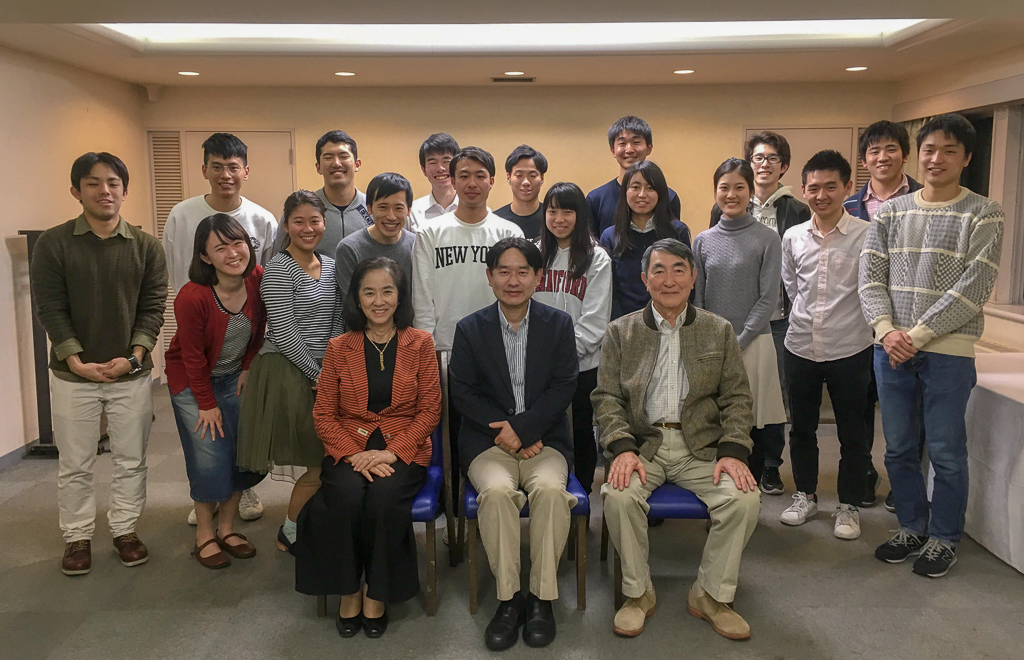
Mr. Yutaka Aiyama
After graduating from Keio University, He got a job at Japan Federation of Economic Organizations. From Federation of Economic Organizations, he went to Yale University Economics Graduate School (master’s degree) and Harvard University Political Science Graduate (Master’s degree). In the autumn of 2002 he experienced Harvard researcher (financial major), then retired from Japan Federation of Economic Organizations. Established his own company in January 2003, it reaches present.
November 2018 "A meaning of a World Heritage Sites and the situation in Japan"
The subject of the November Forum was “A meaning of a World Heritage Sites and the situation in Japan”. Hearing a lecture from a speaker, we had a discussion about this theme.
October 2018 "Japanese Social Welfare System and Ourselves"
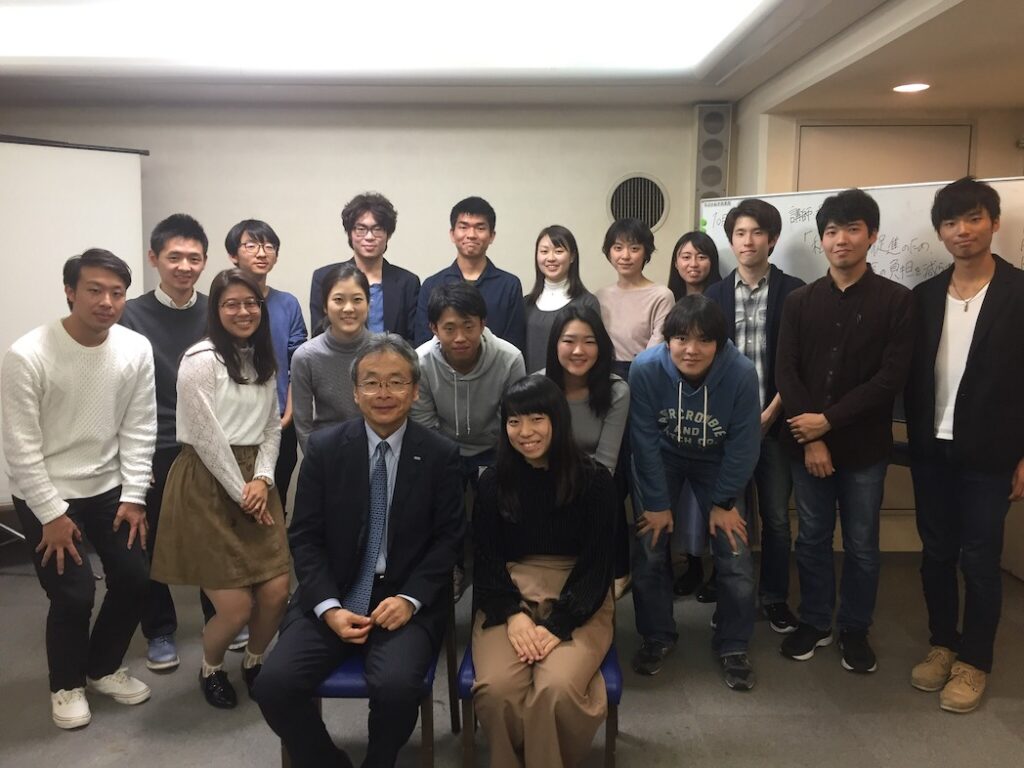
Mr. Fukazawa
He worked for Chiyoda Insurance Company, Limited at first, and then he worked in London. After that, he was a top of International Affairs Department in Asia of Aioi Insurance Company. In Japan, a few years ago, he started up MS & AD research & consulting, Inc, and now he is the sub manager of MS&AD InterRisk Research & Consulting, Inc.
To begin with, he told us the relationship between the social welfare system in Japan and ourselves. Japan has the universal health insurance coverage, which means that every member of the nation must take out national pension program and health insurance. He said we could define pension as a tax.
Besides, he explained an outline of public pension system. Public pension system had three-steps structure. What was interested was how much people can get pension depended on what kind of company they worked for and the way to work. He gave us advice of absolutely checking the pension system of the company which we are going to work for, because he did not know how much money he would get until recently. It was also a reason that more and more company are changing defined-benefit pension program into defined-contribution pension plan to shift responsibility to individual.
In addition, he talked about the flow of public system. The beginning of a story, he affirmed that the public pension system in Japan will remain in the future, because Japan’s Government Pension Investment Fund is the world’s biggest pension fund in terms of assets under management.
After his speech, we had a group discussion of “Should the burden of public pension lighten for promoting private pension.” Most of us concluded public pension ensures a benefit regardless of income, so we should keep the current system. Finally, he said what was important was to learn, understand the pension system and have an opinion many times as time goes. Thank you for an interesting lecture, Mr. Fukazawa.
(Kyoka Ishizuki, Faculty of law, Keio University)
October 2018 "Experience and Business Views Acquired through Investment of Venture Enterprises in Southeast Asia"
In the first half, Mr. Hirota firstly gave us examples of various services that became familiar in recent years, explained what startup and Venture Capital are, and the mechanism of its investment. Unlike traditional small-scale business, startup, which draw a rapid growth trajectory, need funds to support its growth. It is VC to do investment, support, and surveillance for them. VC is a business that finds a company which is capable of turning into surplus with a probability of success of about 7% and monetizes them by selling stocks.
Secondly, he told that the Southeast Asian economy is expected to grow rapidly with a drastic increase in population. He mentioned that mobile devises are widely used, and the size of startup investment is more than in Japan. Among the examples of the unicorn companies and exits, there were companies grew up with online services, transportation network services suitable for Southeast Asia. Examples of deployment of Japanese Start-ups were also seen. Meanwhile, it was suggested that there are many points to be noticed in Southeast Asian economies, such as undeveloped financial infrastructure, communications and logistics networks, differences in business customs and culture, political risks and so on.
Finally, based on the example of the capitalist’s career, he presented some examples of what kind of career we should follow as new graduates. Mr. Hirota jumped into the VC industry after he was sent to a finance subsidiary in Singapore from Mitsubishi Corporation, taken by the region’s incredible economic growth and entrepreneurial dynamism. He told that it is important to acquire own strengths and not to regret own choices.
In the second half, we had a discussion, “What kind of Japanese business is with high value in the Southeast Asia market? And which is better, Japan or Singapore for the business to grow?” Business in various fields such as nursing care, health care, logistics, cyber security, and education came up and many opinions came out that it is better to place a base in Singapore and work closely with Southeast Asia to develop business. Mr. Hirota said it is important to have thoughts to change in the place where you are by getting hints from familiar troubles and success stories of various markets.
In Japan, various services of startups have become familiar and there has been a growing interest in startups for employment. It was not only a valuable opportunity to get more understanding of the structure of startups but to think about career paths. Finally, we would like to thank Mr. Hirota for taking time for us.
(Itaru Ota, Keio University, Faculty of Economics)
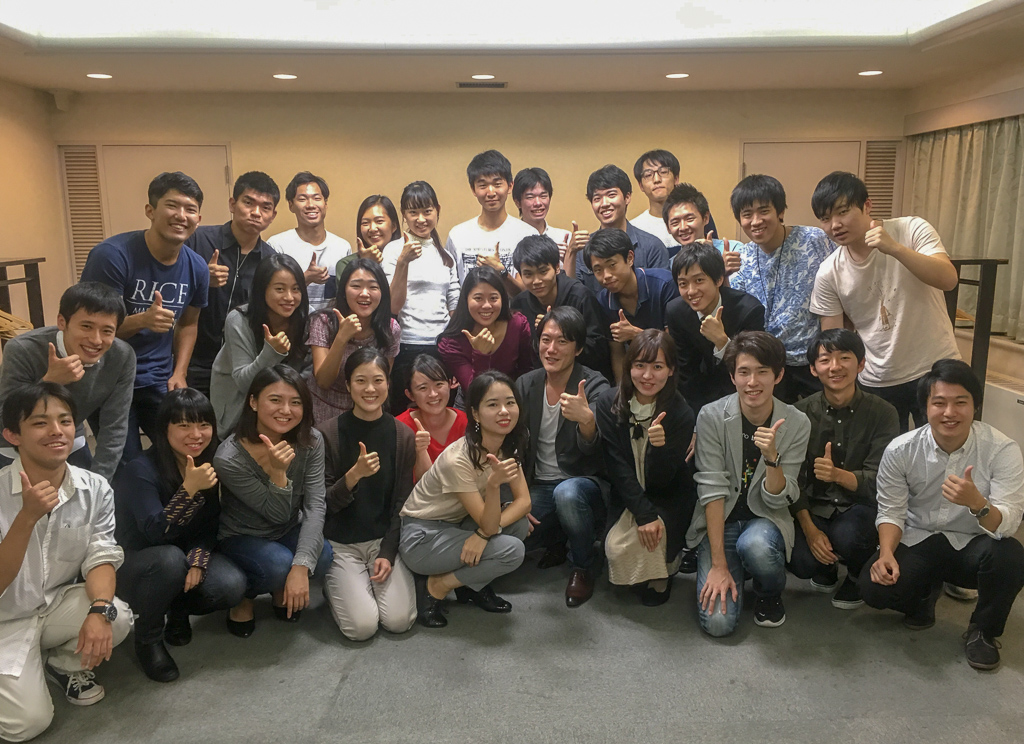
Mr. Hirota
After graduating from Keio University, he joined Mitsubishi Corporation in 2009. After having been in charge of interest rate, foreign exchange, equity trading, and financing support and investment in Southeast Asia, he joined Spiral Ventures Pte. Ltd. in 2015. Currently he is in charge of deal sourcing and growth of portfolio in Singapore, Vietnam, Malaysia, and Philippines as Principal.
July 2018 "The Significance of Working in International Financial Market"
July forum was held. This month, we welcomed Mr. Takizuka who is a member of KIP Alumni. The title of his lecture was “The Significance of Working in International Financial Market”. Mr. Takizuka taught us the experiences in his career and the lessons learnt through it. After the speech, we held a group discussion titled “What We Should Learn Besides University Classes for Our Future Career”.
At the first part, he first told us that whenever one work with others, it is necessary to know about those people and gain their trust. This story was based on his experience of interviewing businesspeople for an economic research. Besides, he also said that we should always think how efficiently finish our job in a limited time.
In the second part, he talked about what he has learnt from his career. He said some of the characteristics of a public institution’s career are that young staffs are likely to be assigned to responsible projects and the job may have a big impact. Furthermore, he said that as he deepens his expertise, it will begin to be appreciated, and that is one of the most attractive features of the job.
After the speech, we discussed “What We Should Learn Besides University Classes for Our Future Career”. There were many opinions proposed by each group, although the most common opinion was that students should take risks and challenge to many chances since students are allowed to make errors. To this opinion, Mr. Takizuka pointed out that usually, students don’t have the chance to get a feedback on what they have challenged. Therefore, it is important to take actions for getting feedback from adults.
In this forum, Mr. Takizuka taught us some lessons through his experiences. These lessons were precious since university students cannot gain them in their daily life. Last but not least, we would like to thank Mr. Takizuka for spearing his time for us.
(Hiroyuki Shimazu)
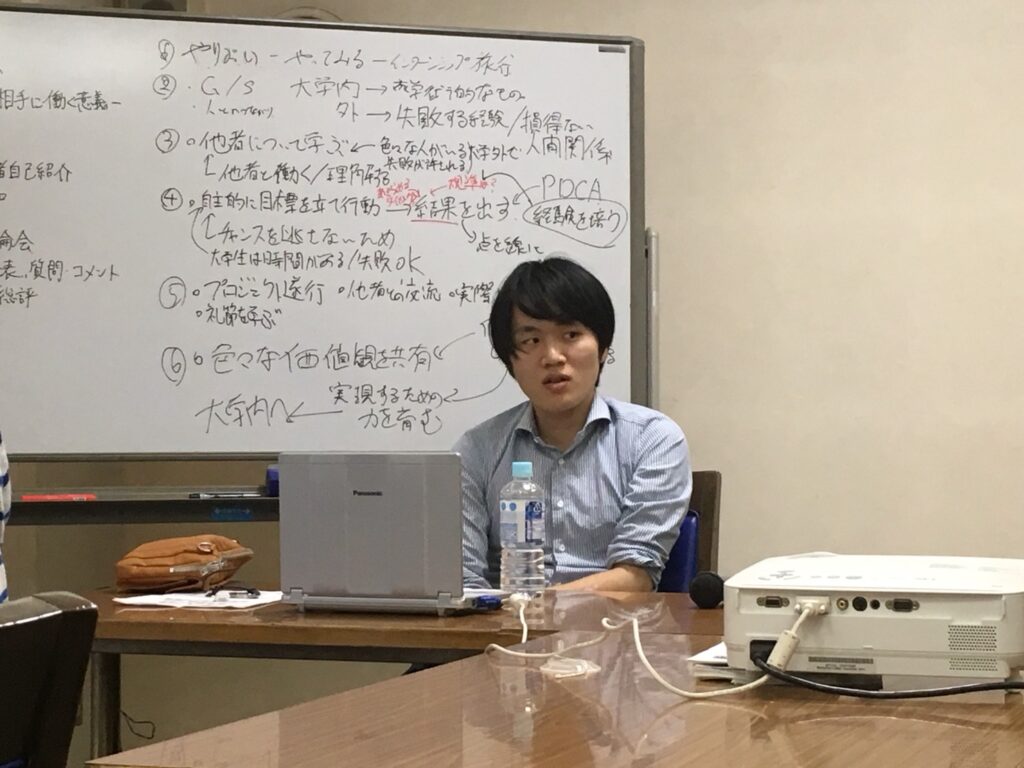
Mr. Takizuka
Studied architecture in undergraduate years and graduated with a master’s degree in economics from the University of Tokyo in 2014. Now he works for a public institution from April 2014.
May 2018 "Significance of the Linear Central Shinkansen and the Role of the Tokaido Shinkansen"
May forum was held. This time, we invited Mr. Koji Kumekawa, Public Relations Department Tokyo, Public Relations Office of Central Japan Railway Company. The title of the lecture was “The Role of Tokaido Shinkansen and Significance of the Linear Central Shinkansen.” The lecture had three important viewpoints, which were “the challenge of the linear,” “increasing the competitiveness of the Tokaido Shinkansen” and “beginning and mission of Central Japan Railway.” Mr.Kumekawa mentioned what kind of changes the Linear Central Shinkansen and Tokaido Shinkansen will bring to Japan in the future.
First, Mr. Kumekawa explained the collapse of the National Railway and the beginning of JR Central from the viewpoint of “beginning and mission of Central Japan Railway”. Specifically, the National Railways from 1949 to 1987 was strongly influenced by politics, and it was difficult to raise the fare or make investments for the future. It caused lower quality of service and lower motivation of workers. Eventually, the National Railways went bankrupt with 37.1 trillion yen in debt. In 1987, the National Railways was divided into several organizations and the JR Central was established. The market of JR Central is 24% of the total area of Japan, which equals to 60% of the total population, and 65% of the total GDP. Mr. Kumekawa said that it is the biggest mission to connect Tokyo and Osaka strongly and certainly, where are main artery in Japan.
Next, Mr.Kumekawa talked about the perspective of “strengthening the competitiveness of the Tokaido Shinkansen.” The Tokaido Shinkansen put much emphasis on six points, including safety, accuracy, comfort, high speed, high frequency, and environmental compatibility. For example, from the viewpoint of safety, they have the prevention system for earthquake disaster to judge whether to stop the Shinkansen, in 2 seconds after sensing the P wave. Also, by pulling the rail inside each of two rails, JR Central is building a mechanism that the vehicle does not derail even if the wheel is detached from the rail.
Lastly, from the aspect of “challenge of linear Shinkansen,” Mr. Kumekawa said that what linear Shinkansen will bring about is roughly divided into three areas: duplication of the artery, integration of the three metropolitan areas by shortening traveling time, and expansion of utility of the Tokaido Shinkansen. In addition, as a meaning for challenging one of the innovative technologies that shinkansen can reach 500 km per hour with 10 cm away from the ground, Mr. Kumekawa mentioned this technology is related with unique background of Japan, earthquake. It is extremely safe even when earthquake has occurred because it will ensure safety. Also, Mr. kumekawa said that while Central Shinkansen was created JR Central covering all the expenses of construction.
Based on his speech, we had a group discussion about “the advantage and disadvantage of Linear Central Shinkansen.” If business trip between Tokyo and Osaka takes only one hour, there are many advantages. For example, business men can save some time and they don’t have to live alone away from their family. Moreover, most people will be able to travel easily and mobility of people will increase. The disadvantage is that it can have negative influence on the environment such as mining of tunnel, and the number of people staying at accommodation facilities in tourist spots may decrease because it takes less time to trip. Also, the inequality can expand due to the population concentration around urban areas.
Mr. Kumekawa said that forming urban areas with scale of 60 million people by opening linear is unique in the world, and this lecture is valuable opportunities considering how Japan will change in the future. Thank you so much for taking some time for us having the wonderful and meaningful forum.
(Ryosuke Noda)
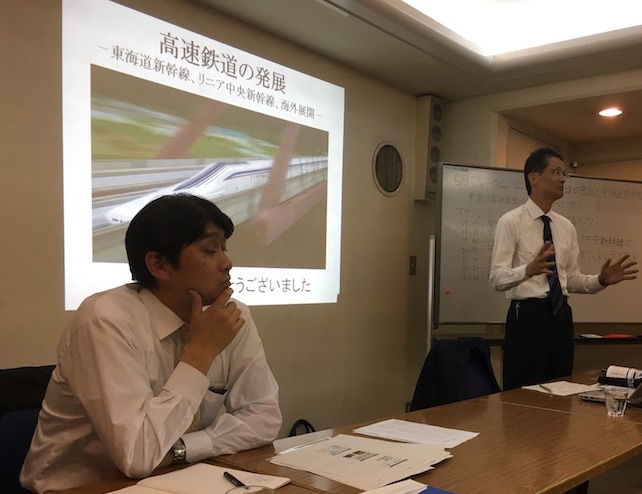
Mr. Kumekawa
After joining in Central Japan Railway Company, he worked as a management trainee and in the human resource department. Now, he belongs to public relations department as Tokyo public relations department’s general manager.
April 2018 “Nissan Intelligent Mobility Vision”
Firstly, Mr. Schillaci talked us about “How Nissan takes action for global issues as a leader in the world.” For example, Nissan tries to develop zero-emission cars for environment. It is not for Nissan but for customers that they try to solve social issues. Nissan thinks about customers at first, and they are developing new technology with alliance companies.
Secondly, he talked us about “the future of car industry.” Recently, the automatized Uber car ran down a pedestrian. The incident raised problem about which person or company has the responsibility of the accident. Mr. Schillaci told us Nissan is still on the way to find the answer.
Thirdly, Mr. Schillaci pointed out “the problems of Japanese society.” That is Japan do not have diversity of people. Even though Japan was praised for its rapid rebuilding after World War Ⅱ, Japanese developing rate has declined after burst of Japan’s economic bubble. Japan would be left behind if Japan do not accept diversity like China or Singapore, and other countries developing rapidly.
Finally, we discussed “Do you think car ownership desire by the youth will be lost or not in the future?” We concluded that partially young people will lose it. We found there are mainly two kinds of desire. One is the desire as a way of moving. Second is the desire to show cars as a status or collection for fun. We reached the former desire would be replaced by public transportation or car sharing. On the other hand, we concluded the latter one would not be ceased because people want differentiation from others as human nature.
It was a precious opportunity for us to rethink about the future of car industry and Japan. We are so grateful to Mr. Schillaci. Thank you very much again for this great time.
(Miyuu Matsuzaki)
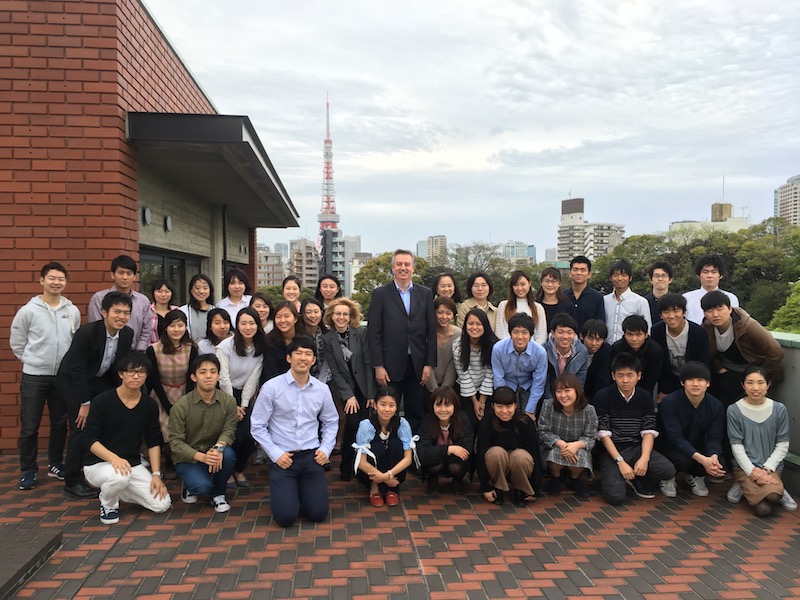
Mr. Daniele Schillaci
Mr. Schillaci graduated from the Polytechnic University of Milan in 1993 and became an engineer in new industrial technologies & business management. Mr. Schillaci began his career at Renault, and moved to Fiat, Alfa Romeo, and Toyota. Right now he is Executive Vice President at Nissan.