



March 2024 "The Governance Structure of Japan"
【Speech and Q&A】
The speaker told us about the ‘factions’ in Japanese politics, their origins (e.g. electoral system), and their roles (e.g. elections, funding, winning posts). He noted that there have been significant changes in Japanese politics in recent years, such as the political reforms since the 1990s, the era of Koizumi and Abe administrations, which have strengthened politicians’ influence over policy making.
【Ground discussion】
Discussion was held on the theme “Should factions within political parties be dismissed?” Some argued that the primary functions of factions, which are backed by funding and post acquisitions rather than policies or belief, are undesirable. Others argued that since the it is natural for members in a large group to form their factions and this tendency is irresistable, the current problems should be approched with this style. Questions were raised as to what criteria should be used to appoint people to posts if factions are dismissed, and whether organizational support is essential for young people and women to win elections and be appointed to positions. Both groups were common in that they were critical of the current ‘factions’, which were formed for the purpose of gaining posts and funding. They, however, accepted the existence of ‘groups’ within a political party, and there was further discussion about what the criteria for joining a group should be.
【Personal Opinion】
This forum was very informative, as it is difficult to learn about the current political situation, which is important, by reading books and other means by myself. In the debate, I was initially in favor of dismissing the factions. However, after reconsidering and revising my opinion while listening to participants with different views, I realized that although there are problems with the current ‘factions’, it is natural for like-minded people to form groups, and after solving the current problems, groups within parties can play an active and constructive role in policy making and in nurturing younger members. The discussions were highly useful as an opportunity to consider issues that we do not discuss very often, and to improve and strengthen my own opinions by absorbing the views of others. In addition, I found the speaker’s talk on politics itself very interesting. Once again I would like to thank the speaker for his valuable talk.
Masaki Goto, 3rd year, Faculty of Law, University of Tokyo
January 2024 "Should Japanese universities make graduation more difficult?"
Without lectures, the participants frankly discussed the pros and cons of making graduation more difficult at Japanese universities and examined ways to improve the way Japanese university students approach their studies.
【Background】
Japanese universities are often compared to foreign universities in terms of difficulty in graduation. While there are those who argue that graduation should be made more difficult due to the low standard of Japanese university students, it is also true that there are advantages to having more leeway in graduation requirements, such as the ability to devote oneself to club activities and use the time for non-academic human development and social studies. What should students learn at university, and how does this affect society?
【Group discussion and Ground discussion】
Those in favor of the proposal included: “Making graduation more difficult is the best way to make students study seriously” and “A large difference in motivation to study within the university is not a good environment for motivated students”. The opponents of the proposal included: “If graduation becomes more difficult and a student stay in school, even if it is due to a part-time job to cover living expenses, the scholarship will be stopped and the student will not be able to attend school” and “Many skills required in today’s society have nothing to do with academics”. Later, opponents proposed alternatives, such as “requiring students to submit a statement of reasons for their ambitions when registering for a course” and “making the quantity and quality of comments in discussions the subject of evaluation”. However, realizing that these will make it more difficult for students to graduate in the end, the topic shifted to the significance of the university’s existence. Here, the participants mentioned that “by linking academics to social contribution, students can obtain funding for academic research” and “to begin with, the job-hunting schedule prevents students from concentrating on their studies, and it can be said that the social system is more problematic”.
【Personal Opinion】
Although divided in favor and opposition, both sides shared the same sense of crisis over the fact that academic significance is fading away in Japanese universities. The discussion led to the realization that universities should provide content that fuels intellectual curiosity and that this content should be unique to each university. On the other hand, making changes to the way universities are run entails various risks. As one of the opposing opinions stated, if students who borrow money on scholarship cannot attend college because they cannot graduate, their final educational background will be that of a high school graduate, which will narrow the range of employment opportunities. We felt that careful consideration should be given not only to the method but also to the extent of such changes so that universities do not cater too much to a particular group of students.
Kana Matsuya, Rikkyo University, Contemporary Psychology, 3rd year
November 2023 "Educational Opportunities and DEI in U.S. Universities"
July 2023 "The Artemis Program: Plans to Return to the Moon"
【Speech and Q&A】
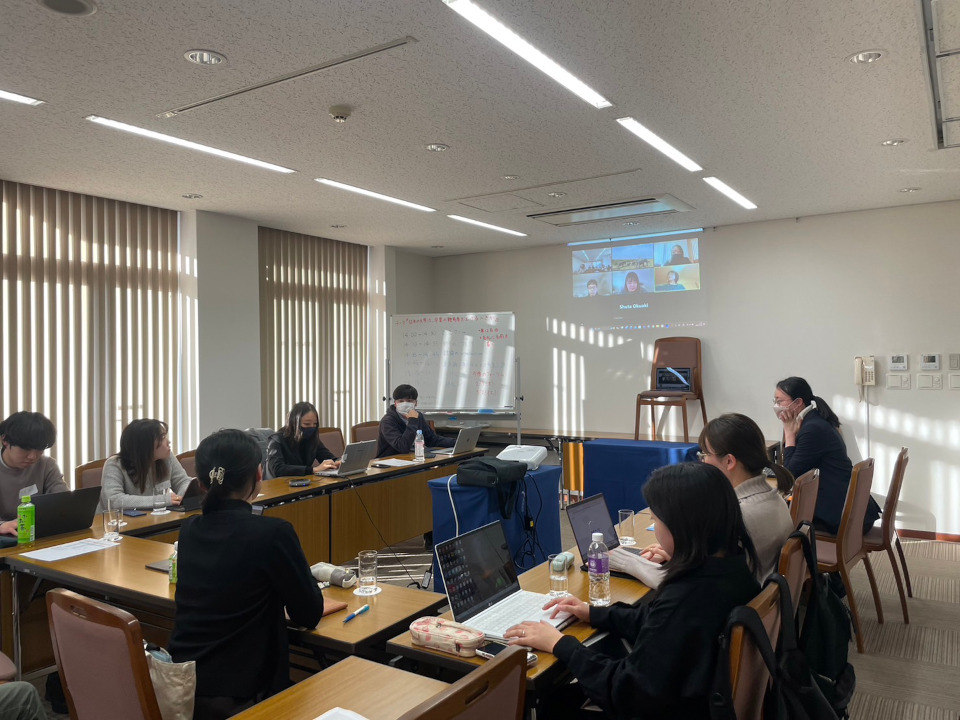
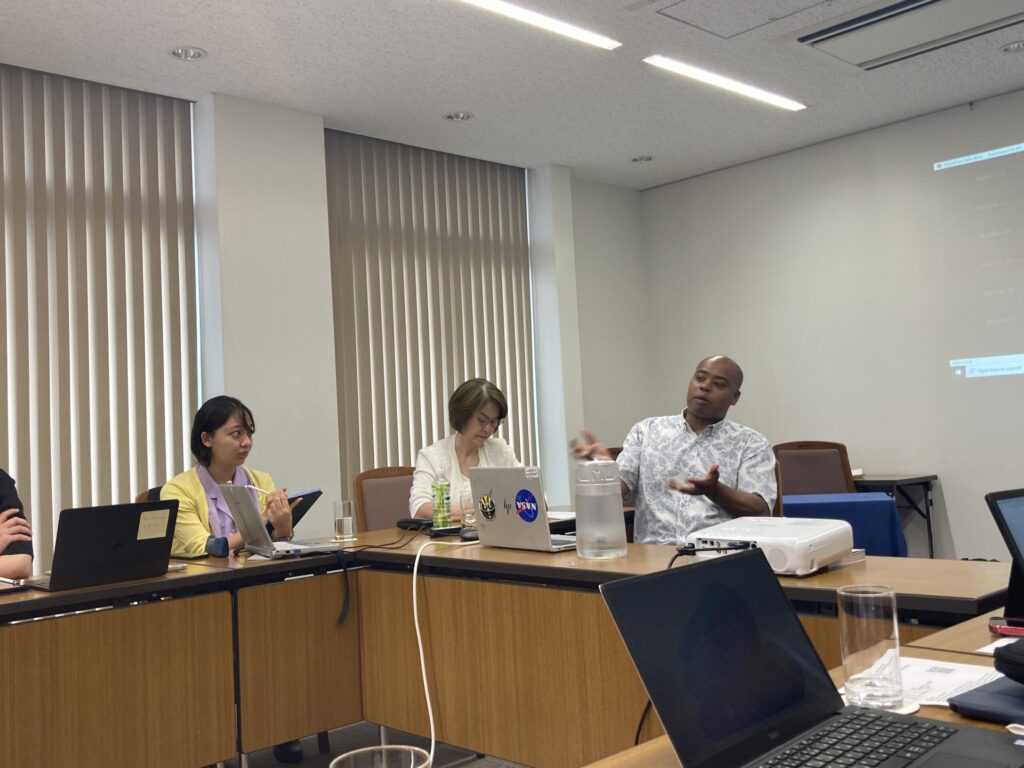
We had the privilege of welcoming Mr. Garvey McIntosh, NASA Asia representative. He provided for us insights about NASA’s symbolic missions and the grand international space industry such as ‘The Artemis Program’. He also emphasized that they will collaborate with commercial and international partners and establish the first long-term presence on the Moon. During the Q&A session, we had the opportunity to ask Japan’s role, the challenges within it, and how the current international situation may influence it. Through his speech, we were able to feel this vast and dreamlike world of space exploration.
【Group discussion and Ground discussion】
We engaged in a debate regarding the pros and cons of investing a huge amount of money to find a place to live outside the Earth. If humanity’s current pattern of destructive activities persists, we will face the limitation for finite resources in our planet. It was suggested that preparing for such cases and advancing the necessary technological developments would be beneficial for humanity in the long run. Moreover, inspired by Mr. Garvey McIntosh’s lecture, we also explored the implications of Japan’s involvement in those missions from the standpoint of evolving international relations. The discussion served as a catalyst, prompting us to reflect on our nation’s role and its relations with other countries in this context.
【Personal Opinion】
As a person with a background in science, I naturally tend to focus on the technical aspects when discussing the space industry. However, Mr. Garvey McIntosh’s portrayal of NASA’s space development industry was quite inspiring for me, presenting a broad view that includes not only technical and business issues, but also international relations and political considerations. Space industry missions can sometimes be influenced by international issues and may face significant constraints. Nevertheless, the established track record, trust, and purpose that NASA has built over the years encourages companies, governments, and organizations worldwide to cooperate and work together. This enables them to unite and take on such ambitious missions, regardless of nationality or gender. In his lecture, he also elaborated on Japan’s contribution to the mission. It was indeed an honor to be part of such valuable discussions.
Rina Tanaka, Aoyama Gakuin University, Physics, Master 2nd year
Mr. Yoichi Furuno
He joined Recruit Co., Ltd. In 1987 after graduation from the Faculty of Engineering, the University of Tokyo. He obtained an MBA at University of Southern California Marshall School of Business. Yoichi Furuno assumed his present post as Chief Director, Institute for Organizational Behavior Research, Recruit Management Solutions Co., Ltd. in 2009.Mr. Garvey McIntosh
Profile: Mr. McIntosh is currently the NASA Attaché based at the U.S. Embassy in Tokyo. He is responsible for the coordination of NASA’s programs with Japan and other countries in the Asia Pacific Region. Since joining NASA in the Office of International and Interagency Relations (OIIR) over 15 years ago, he has supported international cooperation on the Space Shuttle and the International Space Station, high-energy physics and astronomy, and collaboration with India on the Chandrayaan-1 lunar mission. He also played a major role in the formation and work of the 26-member nation International Forum for Aviation Research (IFAR). Garvey has served as the OIIR Europe Team lead and lead for India, France, and the U.K. He also served as the Executive Officer to the former NASA Deputy Administrator Lori Garver.
May 2023 "Post-Ukraine: What Will Happen to the World, What Will Happen to Japan?"
Mr. Hatsuhisa Takashima
Former Representative of the Japan International Broadcasting Inc.
【Speech and Q&A】
The day of this month’s speech made by Mr. Takashima, who had led the media and broadcasting industries of Japan and the world, was the last day of the G7 Hiroshima Summit by chance. At the beginning of his speech, he referred to the historic day when Ukrainian President Zelensky came to attend the summit meetings in person. Also, he stated that the gathering of the leaders of free nations to discuss issues was a symbol of motive power that moved the world and that movements to support countries in difficulty were great things.
Currently, due to some factors such as the rise of China, “the greatest change in a century” is coming in the international society, in which the U.S. remained the sole power after the Cold War. It means that the U.S. does not dominate the world, as it did in the latter half of the 20th century, that the world is starting to move against the will of the U.S., and that a new era is coming to us.
After that, Mr. Takashima, who mentioned Ukraine and Russia, talked about the present situation of the invasion based on his analysis including the situation of European countries’ military support for Ukraine, and noted that the two countries were in a situation of checking each other. Moreover, he touched on the future international situation: how each country in the world will cope amid the intermingling of the Russian side’s desire to invade the territory and the Ukrainian side’s desire to fight for its own defense.
In the Q&A session, we were able to learn the topic more deeply because Mr. Takashima courteously answered questions about the role of Japan in the future international society and the “dark” side that was not covered in the coverage.
【Group discussion and Ground discussion】
The discussion of “Should media be neutral?” was heated in both the groups and the whole. Each member made their own ideas by thinking of the following questions: what is “media” in this context, what does “neutrality” mean, and is it possible to be “neutral” in the first place? However, each individual had different ideas, and thus my group was divided into two sides. We, against each opposite side, contributed to the discussion with a sense of ownership by describing concepts to the other side using examples, because media was closely connected with our life. Even in the whole discussion, the opinions differed from group to group, but we were able to exchange ideas and build constructive discussions. The discussions that got to the heart of the theme were developed from multiple perspectives including the viewpoint of the role of the media (specifically, mass media) in accurately conveying facts for the public; the viewpoint of the receivers such as viewers and readers, who ultimately judge the information; the viewpoint of a different attitude, like sincerity, that information should be communicated separately from facts and opinions. In addition, I would like to add that the contrast between the Internet media represented by social media and traditional mass media was also a key to the discussion.
As an overall comment, Mr. Takashima gave his opinion on the importance of conveying necessary data clearly in detail and of focusing on the receivers of the information.
【Personal Opinion】
I have felt two main things throughout the forum. The first one is about international relations and peace. Recently, KIP dealt with themes of international relations. This indicates that the necessity for us to look at the “outside” has been growing (this is a necessary attitude for “an international-oriented person”). We can learn from history that a substantial number of wars have broken out between nations due to differences in ideologies, races, and languages. I have keenly felt that not only the leaders who visited Hiroshima but each of us should have the attitude toward the pursuit of peace intentionally in order to abolish tragic events in which people on the same planet kill others.
The second thing is about the role of media. As for me, who would like to engage in the media industry in the future, this month’s forum was an opportunity to consider the existence of media. Media plays a great role in individuals and societies. How will I get along with such media, and how will I operate it? I would like to consider the importance of connections between senders and receivers again and make future learning more meaningful.
Each of Mr. Takashima’s words was greatly dignified and touching. This is because, I guess, Mr. Takashima himself experienced times of social upheaval and because his words were reflections of his belief to convey information precisely and quickly as a journalist. I wanted to conclude the report of the May forum by introducing content that especially impressed me — war is the worst thing that humans continue to bear. It is an eternal challenge to reduce the “evil.”
Shuta Okuaki, The University of Tokyo, Natural Science I, 1st year