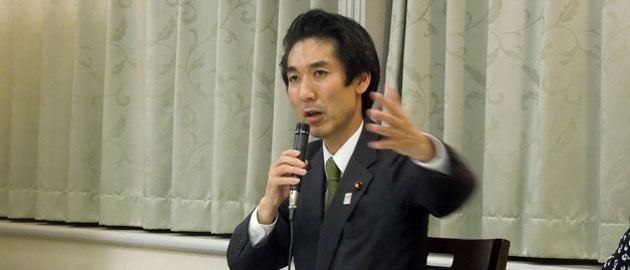



February 2014 "the field of international business and the way to Japanese who are competitive in such field"
Mr. Yasuda gave us a lecture about the styles of competitive Japanese in international business field.
As the world became more globalized, international businesses have been taking place across borders. Because the English language has been recognized as an international official language and that variety of networks are available today, the outline of the international society has changed greatly. Are the Japanese people accommodating ourselves to the waves of changes? The answer is no.
However, the Japanese society is not the case in terms of globalization. The government and companies have been putting much effort into global communications, although it is not spreading throughout the individuals. We, the Japanese people have only a little chance to acknowledge the trends and movements outside the country as an individual. We are taught the grammatical rules of English but not how to actually talk in English. The typical lifestyle of the Japanese people is dependent on a single language and culture which implies that Japan will be left behind from the global community in the future.
In order for the Japanese people to have strong presence in the international businesses, there need to be global communication of individuals. People form their identities as a part of the world through global communication. The Japanese people are expected to reconsider ourselves by comparing with others in the global context.
Mr. Yasuda mentioned that humanity as an individual is indispensable to have a presence in the global business. In order to show one’s leadership, it is crucial not only to have the ability to reconcile differences in opinions but also to have personal magnetism.
I believe that personal magnetism is the ability to urge upon the people’s conscience. When one is in the global business field, there are always confrontations or disparities in opinions with others. Persuasiveness is significant in order to exert one’s leadership. One must understand the purpose and make sure the people around are well aware of the issue.
I strongly believe that even though we all use different language and have different cultures and sense of values, we share the same conscience. Sense of values and historical awareness are important time to time, though it is also important to win the hearts and minds of the people. Someone with the ability to seize the attention with his philosophy and mind, I believe, is the leader who is expected to lead in the global business field. (Jun Watanabe)
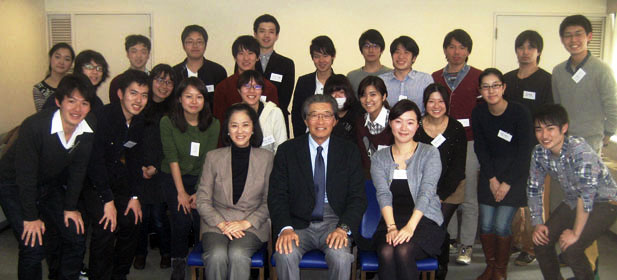
November 2013 "Mysterious particles that fill the universe: Higgs"
For our Forum in November, we had Professor Murayama, a particle physicist, to talk about atoms, elementary particles, dark matters and higgs, newly observed particles. Our theme for this forum was “where did we come from?”, and Professor Murayama gave us the answers by referring to the up-to-date origin of the world.
For our Forum in November, we had Professor Murayama, a particle physicist, to talk about atoms, elementary particles, dark matters and higgs, newly observed particles. Our theme for this forum was “where did we come from?”, and Professor Murayama gave us the answers by referring to the up-to-date origin of the world.
Especially for science students who will probably become the bridges between science and the society, the lecture was very suggestive. Professor Murayama made his lecture very clear and easy to follow by using a variety of jokes and metaphors, otherwise the forum would have been just as difficult and abstruse as the topic actually is. He did not just tell us the facts by listing technical terms, nor he missed the true nature of the topic, but he showed us the importance of understanding the audience and knowing the priorities. After the lecture, we discussed about “by who and how should the budget of science be determined?” And through our discussion, we learned the significance of the ways in which the people taking part in the scientific field transmit their research to the society. (Akira Endo)
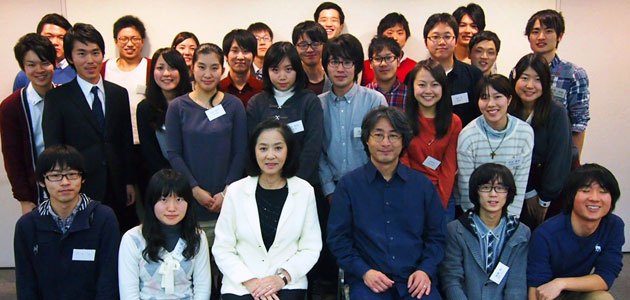
October 2013 "the broadcasting ability of Japan"
We invited Hatsuhisa Takashima, who was a chief commentator at NHK, a spokesperson at Ministry of Foreign Affairs, and a CEO of Japan International Broadcasting Inc.. He gave us a lecture about “information transmission capacity by Japan.”
How can you make people listen to your speech carefully? Through this KIP forum, I found that it is necessary to make them listen it. When you inform to others, one of the key points is to understand what kind of culture or rule listener share with in the forum. Mr. Takashima showed us the IOC meeting, which decided Tokyo as the place of Olympic in 2020, as an example. Modest speech like Japanese style does not work well there. That is because the meeting respects rather the West, Europe culture than East, Japanese one. So you have to have a confidence and to make a powerful speech there. In the meeting, you also need to use English or French there as much as possible. Whether you are worse these language, the listeners pay attention more to your speech than using other languages. On the other hand, when you make a speech to Japanese, it is necessary to respect Japanese culture. If you make it with the Western style, Japanese listeners will not care your speech. (Yoji Nakamichi)
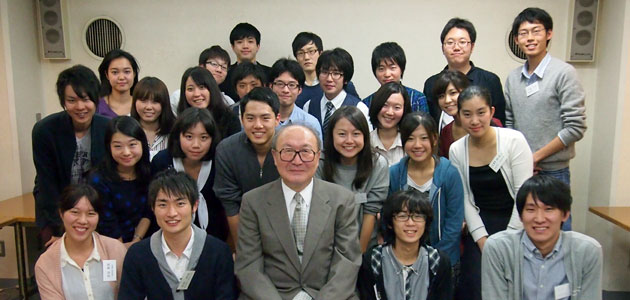
August 2013 "Step to Glocalization Project: Discussion with American Students"
As one of the activities of the ongoing KIP Project we KIP members and students from Dartmouth College and Yale University compared our views on the term. In addition, we discussed the ideal way to revitalize the countryside.
In the first half, we divided into Japanese group and American group and listed some words and definitions that are associated with the term 地=chi within the groups. One of the differences that we saw was that American people imagine places from rural areas to cosmopolitan cities, whereas Japanese people only imagine places far away from large cities such as the word 地方 meaning countryside. The largest thing we had in common is the strong consciousness of belonging towards 地=chi that we imagined. Then, we got into 4 groups and dug deeper into those differences. It was interesting to know that generally everyone in America has a fierce pride in their own image of 地=chi. They imagine a place not simply because they’re born there or it’s their hometown but because it identifies them. I thought this explains their substantial consciousness towards their own identity.
In the second half, we discussed the ideal method for revitalizing the countryside in the same groups. Every group mentioned that we should sustain the local features but the specific ways to do it differed among the 4 groups. Most of them stemmed from the idea that we should stabilize the economy and the mobility of people by conducting public relation activities for traditional industries, specialties, and tourist attractions. One group came up with an idea of “globalization without urbanization” by promoting education. They suggested that by bringing a university into the countryside, more young people will come along with it and would stimulate the exchanges among those students and the local people. Then eventually, more people will have the chance to cultivate global mind in them. I felt this was a valuable idea which relates to a college town such as Hanover where Dartmouth College is located. (Taichi Naka)
July 2013 “A Different Way of Looking at the World”
By Dr. Robert A. Ulmer, counselor (Commercial ・Ontario) at Embassy of Canada in Japan
For our latest forum in July, we invited Dr. Robert Ulmer who is a current counselor at the Embassy of Canada in Japan to hear about his perspective on the importance of knowing and embracing as many different perspectives as one individual can by referring to his own experiences of studying English and Japanese literature, publishing the English translation of “The Lemon” and involving in various activities and fields as JETRO and the financial world of Japan and Canada.
Dr. Ulmer emphasized on the significance of seeking and knowing the value of “En” which can be translated as chances, connections or fate with others. He gave us a number of actual examples he had experienced through the track he has been so far. He also gave us a clue to think about the importance of looking for different perspectives.
In the group discussion we had at the end of the forum, Dr. Ulmer gave us a question, “What is preventing us from seeking for different perspectives?” Several Japanese students insisted that there are cultural and customary reasons for Japanese people not to seek for different ways of thinking by quoting a proverb “The stake sticks out gets hammered in”. Some others came up with the ways how to be aware and familiar with different viewpoints.
Through this forum, found out that the term “En” is what we gain from our imagination that is framed by the information and different senses of values that we come in touch with in our daily lives. And I believe that showing our interests in a variety of phenomena and seeking to know different perspectives are significant in forming this imagination. (Mami Takano)
June 2013 "Attitude toward international conferences: How to forward thenegotiations with foreign people"
Forum in June: We invited Mr. Chihiro Sakuraba, who is the Deputy Director-General of International Department, Bank of Japan. On the title of “Attitude toward international conferences: How to forward thenegotiations with foreign people”, Chihiro Mr.Sakuraba gave us a speech. He talked about the reality of international conferences and tactics that leads to successful negotiation. His stories from his own experiences in the previous G7 affiliate meetings were fully shared by the forum participants. A selected case was the 2001 crisis management in Turkey. Following a general explanation on the economic crisis in Turkey, ChihiroMr. Sakuraba explained the difference of objective among G7 countries as well as the financial assistance from the International Monetary Fund (IMF).
He also taught us the importance of seeing through the essence, throwing away our prejudices and persuading other persons in a brief manner.
At the last session, we did case study about central bank liquidity swap arrangements among Japan, China, and South Korea. Every team discussed from a different perspective and reached a unique conclusion.
Through case studies, I we studied two important points on how to get a successful persuasion. The first point is to show clearly the difference from the other teams. The second point is to focus on only one main point. And I think I we also learned that we should get capacity of adapting to the circumstances, flexibility toward any changes and capacity of extracting the essence. (Shun Hasegawa)
May 2013 "NanoJapan+KIP Discussion"
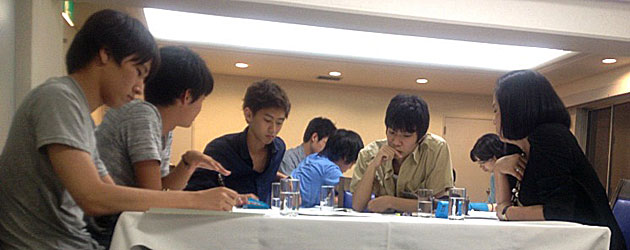
At the 3rd session of NanoJapan+KIP discussion, NanoJapan students, KIP students and the KIP director Mr. Ito discussed “Should all students be required to study Liberal Arts, instead of taking professional education?”
The theme comes from the KIP project last year, through which we found that the Japanese companies think highly of the liberal arts, or general education for students.
We had discussion in English in a group which has both NanoJapan students and KIP students. Three groups answered yes to the question above, and one said no. The reasons for yes are to have broader perspectives, to keep balance even though one is determined to pursue particular study and so on. They answered no because they think they should teach in higher level in universities and liberal arts is taught enough by high school. In Q&A session, Mr. Ito told us his own experience at boarding school and university in the U.S. and we got to know that everything related to university or college such as life in a dormitory and club activities is also considered liberal arts.
In Japan, by and large we have less liberal arts education as we become senior. However, they have certain portion of liberal arts every year in the U.S. This difference of systems results in the difference of how we think of liberal arts. I also surprised at the fact that almost all of NanoJapan students, all of which are science students, are taking liberal arts education and they feel it interesting and important. One of them said he took the philosophy courses because its essence is the same as his study, physics, in that both come from the question “What exists behind the fact?”
In the discussion, whether it is good or not, I was impressed by their eagerness that they want to tell their opinion. For instance, they cut into someone’s talk and ask questions whenever they don’t understand. That made me feel I am in the middle of “American style” discussion and it was quite stimulating.
(Yuki Kawakami)
April 2013 "Politics and Diplomacy in Japan"
Forum in April: We invited Mr. Minoru Kiuchi, who is a member of the House of Representatives to give a lecture about “What is a significance of our life?” He talked about his own experiences and how to face with current problems.
In his speech, he emphasized that Japanese people need to have their own identity as Japanese citizens. Now we have the Internet and we are free to connect to foreign people. The world is going to become global. Thus when we contract or negotiate with foreigner, we have to stand a point of view as Japanese. He has suggested that we need to study and understand Japan correctly.
He also taught the importance of finding a real character of the problem. Now we have a lot of problems to solve. He told that it is necessary to see problems from many aspects. In addition, he said that it is important to judge by ourselves. We should not believe easily what others say, only because it is common to many people, but we should try to find the fact and understand it by the real nature of the problem. (Takatoshi Nohara)