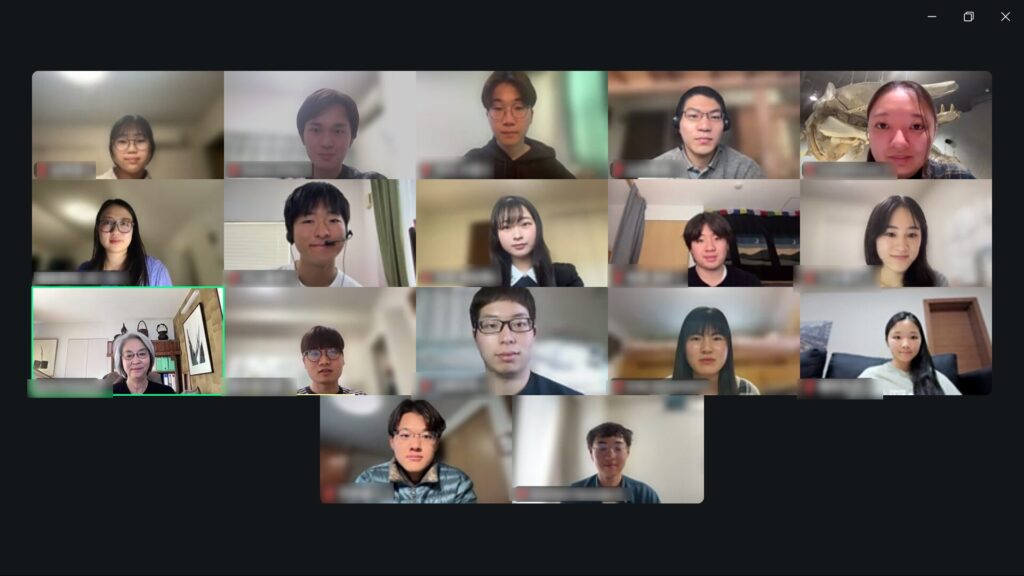



Lecturer: Ms. Mana Kamakura
Profile: Ms. Mana Kamakura is a Master’s student at the Yale School of the Environment, specializing in “Business and the Environment.”
She began her career at the Ministry of the Environment, Japan in 2019. Throughout her tenure, she managed a diverse portfolio, including international negotiations on plastic waste management, joint promotional campaigns for renewable energy and electric vehicles (EVs), and ministerial restructuring. Prior to her arrival at Yale in the fall of 2024, she served in the Cabinet Office, where she focused on nuclear emergency preparedness. She is currently bridging her extensive experience in the public sector with business perspectives to drive sustainable solutions.
【Speech and Q&A】
In the first half of the lecture, Ms. Kamakura talked mainly from her perspective as a graduate student currently studying at Yale University. She explained the relationship between the Trump administration and the Ivy League, and she also gave an overview of how energy policy may change under the One Big Beautiful Bill Act (OBBBA), a bill proposed by the Trump administration.
About the Trump administration, she especially mentioned several actions that were demanded of Harvard University around April–May 2025. These included measures related to antisemitism (including controlling or stopping protests), ending DEI (diversity-related programs), freezing research funding worth several billion dollars, and suspending Harvard’s ability to accept international students. Even if not all these statements become real policies, I felt again that the actions that were actually taken already had a big impact.
Next, she talked about the OBBBA. It is a large bill that covers many areas such as tax changes, national defense, border security, and energy policy. It also seems to be pushed forward quickly. In terms of content, it includes major changes to Biden’s Inflation Reduction Act (for example, policies that promote EVs). It also includes policies to strengthen domestic industry and energy security, and it has support measures for the semiconductor sector. On the other hand, inclusiveness and environmental protection are treated as less important, and I felt that this makes the Trump administration’s priorities clearer.
In the second half, the discussion moved to the main topic: rare earths. Rare earths are important for many technologies, such as semiconductors and permanent magnets, but the supply side is still strongly dependent on China. Japan is trying to diversify its suppliers. Japan lowered its dependence on China from around 90% in 2009 to about 60% in 2020, but for heavy rare earths, Japan still relies heavily on China. I was also impressed by the point that China has an advantage not only because deposits are concentrated, but also because China is strong in the “middle and later” parts of the supply chain, such as separation and refining.
On the demand side, China’s EV industry has grown very fast. In 2024, about 17 million new EVs were sold worldwide, and about 11 million of them were sold in China. Still, it is not true that Japan is doing nothing to reduce dependence on China. What stayed in my mind most was the example of Daido Steel, which is doing R&D on permanent magnets that do not use heavy rare earths. I was surprised that there are real successful cases of technology development that reduces (or even removes) the need for rare earths. Finally, Ms. Kamakura mentioned China’s rapid expansion of renewable energy and also pointed out the problem that renewable-energy technologies often depend strongly on rare metals.
【Group Discussion and Ground Discussion】
As international competition to secure rare-earth resources becomes sharper, we discussed what kind of technology strategy Japan should take and what position Japan should aim for internationally.
Across the groups, the most common idea seemed to be that Japan should first prioritize technologies that reduce rare-earth use or replace rare earths with other materials. Another idea was that Japan should not look only at productivity and cost but also pay attention to human rights of workers and environmental burdens (such as waste treatment) in mining and refining. Some groups suggested that we should make these points visible and share their importance more widely in society.
For international cooperation, ideas included working with countries that have deposits but have not developed production yet and providing economic and technical support so that producing countries can complete refining within their own countries. In my group, logistics cost also became an issue, and from that viewpoint as well, I felt that supporting producing countries to build the middle and later parts of the supply chain is a reasonable approach.
【Personal Opinion】
Through this forum, I felt China’s influence across the whole supply chain—especially the parts after mining, including separation and refining—more strongly than I expected. At first, I thought the main reason for dependence on China was simply that deposits are concentrated there, so maybe the problem would be solved if Japan could secure stable mining rights in other countries. However, I learned that China also has the biggest presence in the middle part of the supply chain, and that dependence on China is a deep and persistent issue.
At the same time, I also realized that Japan is steadily building concrete efforts, such as technology development and supplier diversification. From what I checked beforehand, there is an example of rare-earth recycling technology jointly researched by Nissan and Waseda University. Also, as mentioned in the lecture, Daido Steel’s R&D on permanent magnets without heavy rare earths is another important example. For international cooperation, Japan is also building a framework for long-term supply of heavy rare earths from Australia.
For Japan, which is relatively disadvantaged in terms of natural resources, technology development and international cooperation are clearly essential. That is why I strongly felt that Japan should think even more carefully, at the national level, about how to allocate limited resources. I would like to express my deep gratitude to Ms. Kamakura for giving her valuable time for this forum despite her busy schedule.
Daigo Ichikawa, the University of Tokyo, Graduate School of Science