

Lecturer: Mr. Akira Igarashi
Profile: After enrolling in the College of Contemporary Psychology at Rikkyo University and completing an exchange program at Leiden University in the Netherlands, they withdrew from Rikkyo University to transfer to Utrecht University in the Netherlands. Following the completion of a Master’s degree at Utrecht University and a Doctoral program at the Tohoku University Graduate School of Arts and Letters, they earned their Ph.D. in Literature in 2019.
Their research focuses on Sociology and Political Science, specifically utilizing statistical methods to analyze discrimination and xenophobia against immigrants. Their recent publications include Discrimination Visualized: Statistical Analysis of Discrimination and Xenophobia Against Immigrants and Ethnic Minorities (Winner of the 68th Nikkei Prize for Excellent Books in Economic Science).
【Speech and Q&A】
At this forum, Akira Igarashi, a KIP alumnus and associate professor at the Graduate School of Human Sciences, Osaka University, gave a lecture. In line with the content of his book “Discrimination Visualized”, he explained using many examples and data about “how to correctly recognize discrimination?”, “what kind of discrimination actually exists”, and “how to classify the causes of discrimination”. In addition, Mr. Igarashi’s specialty is immigration, so he talked a lot about discrimination against foreign workers and residents in Japan. In addition to KIP members, members of the Center for Japanese Studies of the United States and Canadian Universities participated in a lively Q&A session. There were very diverse questions and answers, including questions about the content of discrimination, such as discrimination by foreign workers in Japan and ethical issues in field experiments, as well as questions about research and experimental methods.
【Group Discussion and Ground Discussion】
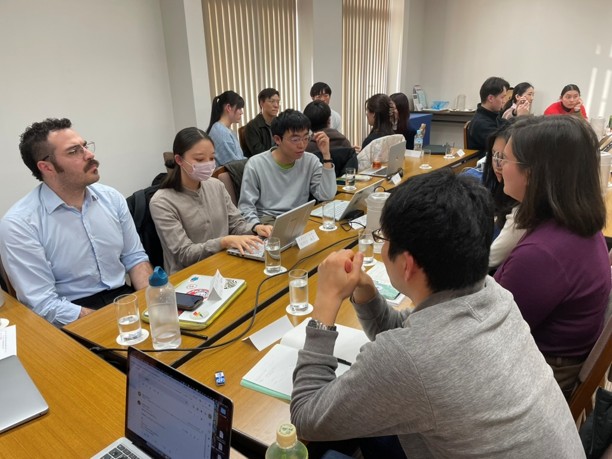
The theme of the discussion on “How to eliminate discrimination” was discussed in four groups, including members of the Inter-University Center for Japanese Language Studies. One of the most popular opinions was to approach discrimination based on preference among the two causes of discrimination, such as reducing prejudices about foreigners and immigrants through education and deepening understanding through exchange. Also among other causes of discrimination. Regarding statistical discrimination, it is discrimination that arises from inferring unknown information about an individual based on statistical data, and in order to reduce such discrimination, opinions were expressed such as properly presenting information in resumes.
【Personal Opinion】
At this forum, I was able to understand “discrimination” in detail, which I had only vaguely understood until now, structurally and through data, and I learned a lot. This time, I mainly talked about discrimination against immigrants and foreigners, but there are various other forms of discrimination in modern society, and I felt that it would be good to have the opportunity to learn more about them and think about them in the future. I also learned the importance of asking questions that I want to know in a limited amount of time. This time, in addition to the general discussion, there was a group discussion, so the time was more limited than usual, so the chairman gave advice to the whole group to ask short, easy-to-understand questions and remarks, and I learned that I would like to be aware of it in the future.
Yukina Ono, Yokohama National University, Economics, 4th year