





February 2013 "The Rise of Contemporary China and the Transformation of the Asia-Pacific : Current Politics and Future Prospects"
First of all, thank you for coming to the forum despite of your business. It was really great opportunity to know the situation of Hong Kong. I appreciate for your coming. From here below, I’ll write about what I thought after the forum.
First, I agree on your pessimistic view on the future of Hong Kong and the simile with the Trojan Horse for the democracy is really persuasive. But as for your optimistic part of view to keep away from the obedience to the mainland China, I’m more pessimistic especially in the political aspect. If other countries in East Asia really exceed in the freedom and such values, it would have influence for China to open their country more, and accept further democratic systems. However, in such transitional situation from communism to democracy, mainland China would be more reluctant to have democratic region inside the country to moderate the movement to the democracy. On the other hand, such regional influence may contribute to the maintenance of the position of Hong Kong in economic privilege, since the expansion of free trade is much less controversial issue in China, and to have such special zone is common in China so it would be broader room to accept the special position of Hong Kong in economics. So through this argument, my view of future Hong Kong is that they keep the advantaged position in economics though the gap may shrink but they would lose the privilege in political sense even if China will slowly move to democratic regime.
As for the last discussion, my conclusion is that Hong Kong is really great city we need to deepen our relationship with, but to pick out special position on Hong Kong is overrated. We cannot have political impact through Hong Kong to China. In economic viewpoint, I agree that Hong Kong would be one of the most attractive cities to put the branch with the loose restriction on the business, accumulation of resources. But I think these merits aren’t the crucial difference from other cities like Shanghai and Guangzhou. So the importance of Hong Kong still exists for Japan, but I believe we don’t need to put special focus to on Hong Kong; just see them parallel to other prosperous cities in China.
At last, I want to show my deepest gratitude for your lecture again. Since I didn’t know much about Hong Kong, it was great opportunity for me to deepen my knowledge on Hong Kong and great trigger for me to have interest there. Thank you very much.
(Masafumi Kawasaki)
January 2013 "Discrimination and prejudice in America"
Forum in January:One of the directors of KIP, Mr. Koichi Ito gave us a speech about discrimination issues that are untouched in many cases, based on his own experiences in both Japan and the United States. He talked about the discrimination in the US, a country that is worldly recognized as a place of liberty, such the discrimination against African Americans, looking back to his own experience and the history of discrimination in the US. He mentioned that Japanese people were not the exception of the target of the discrimination and that there were discrimination concerning the Occupation Army. In the latter part of his speech, Mr. Ito talked about social integration issues as one of the discrimination in Japan. The difference between the Japanese way of dealing with discrimination issues and that of American was raised as his question to the attendees. (Shunichiro Nakano)
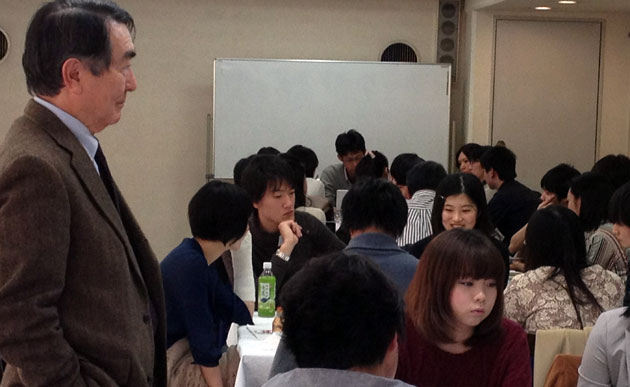
December 2012 "How Mr. Niinami sees Japan and the world"
Forum in December : We invited Mr. Tsuyoshi Niinami who is the president and CEO of Lawson, Inc. On the title of “How Mr.Niinami sees the world and Japan”, he gave us a speech. He talked about his own career, the prospects of Japanese economy and what the higher education ought to be.
This time we asked Mr. Niinami to make a speech on what he wants to talk about. After his speech, KIP members ask him some questions. I think this forum was held in a friendly way because we talked with him over dishes and drink on the table. I found his opinion on TPP* very impressive. I thought such an opinion can be made because he has worked as the Vice Chairperson and Executive Director of Japan Association of Corporate Exectives. He also talked about so-called “liberal arts”. By referring to learning history, Mr. Niinami said that we can enrich our way of thinking. However, liberal arts tend to be made light of at universities because it is not necessarily practical. The fact that Mr. Niinami has such an idea, therefore, was surprising and impressive. (Keisuke Iida)
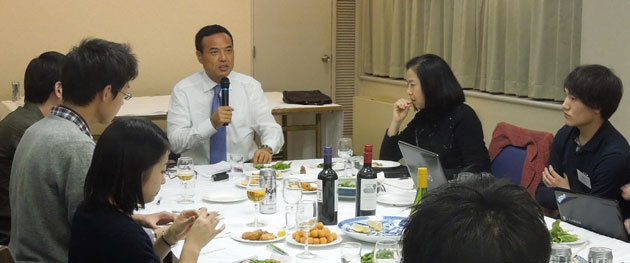
November 2012 "Way of a corporation between Japan, China, and Korea"
Forum in November : We invited Mr. Choi, Sang-yong who was the Korean Ambassador to Japan. On the title of “Way of a corporation between Japan, China, and Korea ” he gave us a presentation from the view of political philosophy that is his major.
Today, the three countries, Japan, China, and Korea, have a great influence in the world. It is meaningful that the three corporate each other, because this can produce a synergy. However, there are two problems at least to realize it.
First, Korea is the smallest country of the three and it cannot be good with the foreign policy if there is no change. In addition, Korea has a difficulty in being a mediating power between Japan and China. Now, it is important to unify the South Korea and the North Korea.
And this needs help from Japan. After a former prime minister, Mr. Koizumi, even if there is a big problem like abduction problem, it is key to take a action from what you can easily do, not to do nothing till a problem get resolved.
Second, that is Nationalism. Today, there are some territorial issues, which are the worst way of Nationalism in historical context. A corporation between historical scholars in each country is significant. They should share facts and accept various interpretations.
In this situation, cultural exchange, mutual learning process, is essential, and I am sure that this indirect effect is worthy. Now, I am trying to establish an orchestra between the three as a mutual learning process. I want to make a soft relationship instead of things like an alliance.
After the lecture like this, we discussed how can Japan help the unification between the North and the South. There are lots of different ideas, like raising a level of economic dependence, making a system of exchange program, etc. I think you have to deeply think of art, which our society does not regard as important but support our inner life. (Soma Nii)
October 2012 "Measuring the National Power"
Forum in October: We invited Mr.Nishizawa who currently works as a head of foreign investigation of Japan Bank for International Cooperation (JBIC). The main theme of his lecture was “Measuring the National Power”. We also discussed about the future Japanese national power. Not only the main theme but also he told us about his career experiences and we could learn a lot from his lessons.
Mr. Nishizawa entered JBIC after his graduation of graduate school and after that he served several important roles at IMF, World Bank and others. He currently gets back to JBIC and works as a chief of foreign investigation.
He mainly talked about how do we measure the national power precisely. He told that it is one of persuasive way to show national power in numbers such as GDP. However, there exists the limit so he asked us how could we measure it not using numbers. There is no right answer for it but one important factor is the trust between countries. He also mentioned that the trust is not only fulfillment of obligation, but also it will be built up by the history of the country.
On discussion, we shared our opinions about”What should Japan do in order to build strong national power”.・In my opinion, I believed that having big presence in the international society is necessary factor to extend the national power. In order to increase the national power, improvement of education and political policy should be done at first and after that those revise will have an effect to the economical side of the country. Japan should not postpone the improvement of the base of the country and make a long-term goal to carry on a few at a time.
Moreover, I was impressed about one of his lesson that there is no useless thing in our life and let’s think all things are convenient for us. Of course, it is important to deicide you goal and pursue only for it but at the same time you can learn and feel a lot by struggling seriously in other field. I thought that I would like to follow the way of this mind-set from now on.
Thank you so much for sparing your precious time and giving us fantastic lecture. (Ryohei Iseki)
September 2012 "Experiences before, during, and after the World War II"
Forum in September: We invited Mr. Ogata, who is familiar with the situation before and after the World War II. He told us about his experiences and what had been going on in Japan around that period. Also, he pointed out some problems we are faced with today, such as “misapplied equality”.
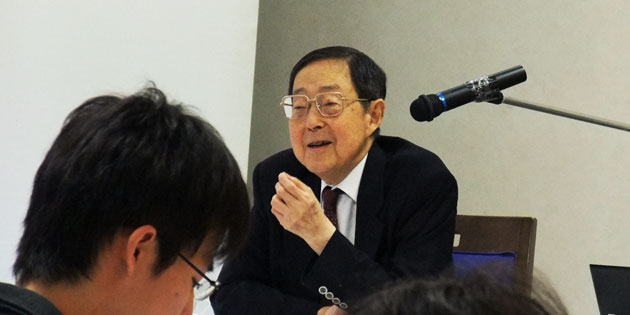
June 2012 “How consultants and their brains work”
May 2012 Discussions with Nano Japan
April 2012 “The integrated tax and social security reform”