


February 2016 "The departure from ignorance"
December 2015 "How should Japan develop globally minded human resource in the next generation?"
For our December forum, we invited Mr. Toshiyuki Shikata, who is one of the directors of KIP, as our speaker. He has been a head of personnel department of the Ministry of Foreign Affairs since July 2014. The title of his lecture was “How should Japan develop globally minded human resource in the next generation?” He told us KIP had been ahead of our time and what kind of role the universities in Japan should play, especially focusing on English education.
In the first half, Mr. Shikata, who has been active in the forefront of the political world, mentioning his own experience, concretely explained about the transition of economic agreements around Japan, U.S.A. and other countries in the Pacific, and the speculation of each country related to the agreements. Nowadays many people have started actively discussing TPP, but according to Mr. Shikata, KIP had done a simulation of TPP long before TPP has drawn attention. Even if we are not politicians, it is essential to think about public policies, and I thought we had to be grateful to KIP for providing us with such opportunities. On the other hand, he raised an issue, “Does the university in Japan properly offer such opportunities? ” In Japan many university students learn liberal arts for only two years, but well-rounded people are welcomed in foreign countries, and he told us that it might be nonsense to divide us into two groups in university or high school, those majoring in humanities or social sciences and science, which I entirely agreed with. This was because I also felt strange that I had to decide which to major in high school. Moreover, he lectured how English, which is “lingua franca” now, meaning it is a universal language, was important in international community. However, many Japanese people suffered from lack of English communication skills. How can we raise the general level of those skills for the survival of Japan? I would like to straightly face this problem, including several indicators for our command of English he mentioned such as TOEFL, TOEIC, and PTE.
In the second half, we had a group-discussion on “Which should we put more emphasis on in higher education, “liberal arts” or ”practical science”? ” As the definitions of the words “liberal arts” and ”practical science” were vague, many groups defined them at the beginning. However, whatever the definitions of the two words were, on the whole we concluded that we had to put more emphasis on what we call ”liberal arts” than “practical science”, for we need a wide knowledge regardless of our majors. Also, some groups were so future-oriented that proposed a measure such as abolishing the credit system in universities. Since the topic was very familiar to all of us, we had a lively exchange of opinions. Last but not least, I would like to express my thanks to Mr. Toshiyuki Shikata for delivering a precious lecture for us in spite of his business.
(Teruyo Fujisaki)
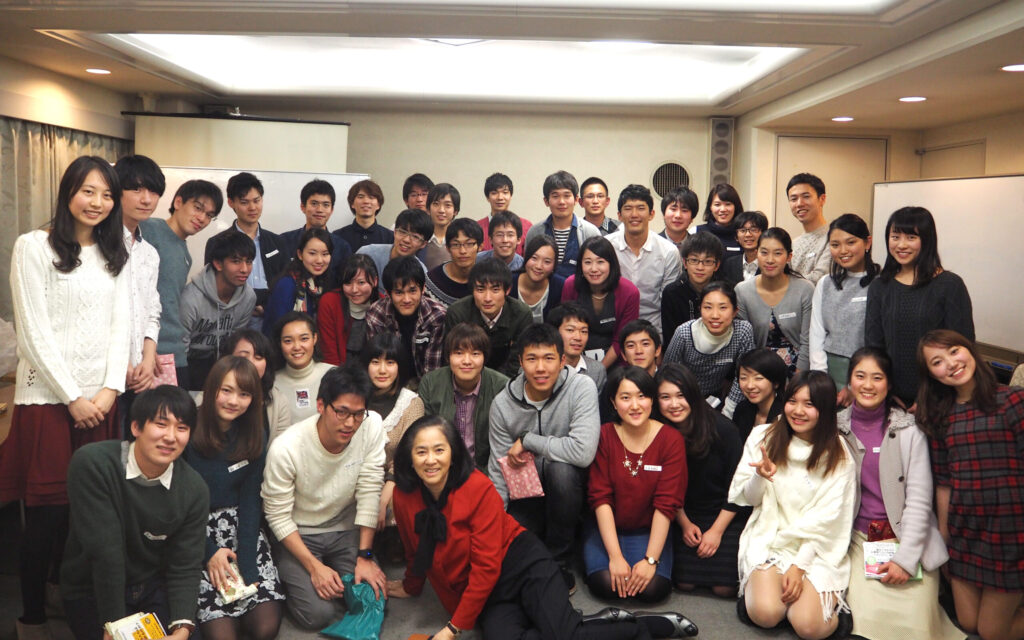
Mr. Toshiyuki Shikata
Director of Personnel Division, Minister’s Secretariat, MOFA
November 2015 "The misunderstandings in the context of globalism"
For our November forum, we invited Mr. Ichiro Fujisaki as our speaker. He served as an ambassador to United States in 2010 and is currently the president of the Japan-America Society and a professor concerned with international strategy in Sophia University. The lecture was about the misunderstandings of globalism. He told us the role of an ambassador to USA from his own experience and, what we should know as a Japanese when we go abroad.
In the first half, Mr. Fujisaki gave us some quizzes on diplomacy between Japan and America and then he talked about 3 categories that are often misunderstood in the context of globalism, which are “country”, “communication”, and “language study”. He also mentioned the 4 topics that Japanese people should be aware of when going abroad. The first is to know the progress of the Great East Japan Earthquake disaster reconstruction. The second is to have knowledge and an opinion about nuclear power plant. The third is global warming and the last one is the issue of refugees. I felt that it is important to know about the situation of our country of an international issue in order to get involved with people all around the world. For communication, Mr.Fujisaki told us as many emphasize how Japanese people should be more expressive of their thoughts and often ignore the importance of listening to others, listening to them should have more weight in communication. He made it clear that in order for Japanese to live through this global era, receiving information is as important as conveying.
In the latter half, we had a group discussion on 2 themes. The first one was “Having little progress in the earthquake disaster reconstruction, is it acceptable to proceed preparing for the 2020 Olympics?” We can expect the economic effect of Olympics, but focusing on the Olympics may lead to neglecting the damaged places in Japan, so one group said that it is necessary to draw attention to the region by mass media. There was another group that said we could invite the people living in a temporary housing to the Olympics for free. Another discussion topic was “Should Japan participate in international community by providing military forces?” People who agree think that playing a military role can enhance the country’s influence on international community. However people who disagree think it is different from current world. Finally, the conclusion did not come out. Both topics were actively discussed because they were important topics for Japan. Finally, I would like to express our gratitude to Mr. Fujisaki for taking time to speak to us.
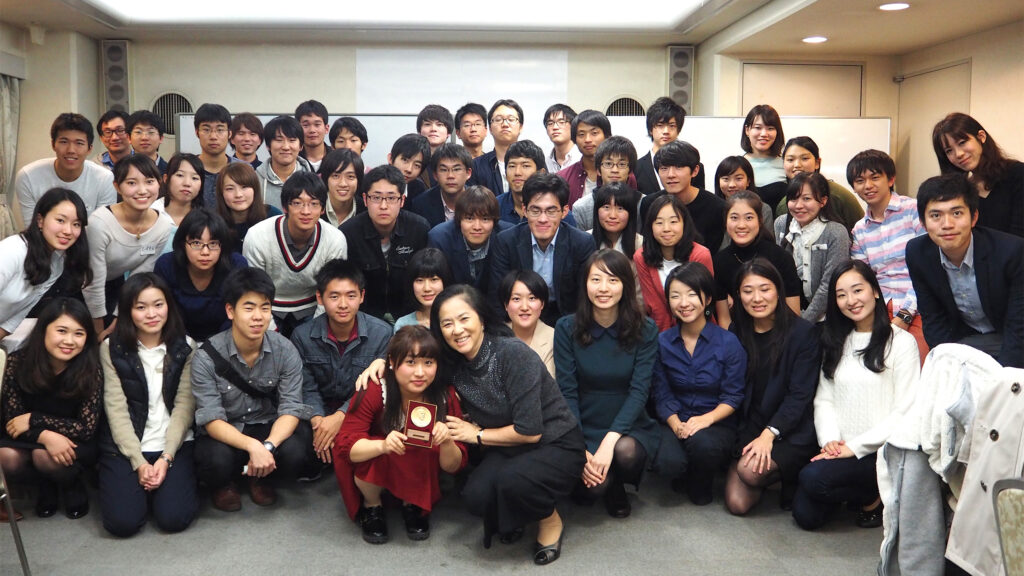
Mr. Ichiro Fujisaki
The former ambassador extraordinary and plenipotentiary to the US
October 2015 "The management of JINRO and relations between Japan and South Korea"
For our October forum, we invited Mr. YANG IN JIP as our guest speaker. He is the CEO of JINRO INC., and is greatly concerned with promoting more interaction between Japan and Korea. The title of his lecture was “The management of JINRO Inc. and Japan-Korean relationship.” The main theme was about how JINRO expanded its market share in Japanese liquor market and how we should take actions to improve Japan-Korea relationship.
Despite the trend of Japanese young people consuming less alcohol these days, JINRO has expanded its share to a high level, which now being the only foreign company ranked in top 10 in Japanese market. What Mr. Yang emphasized about was his endeavor since he took his office as CEO to localize JINRO to Japan that made the company more successful than the other foreign companies. His method, which is not to pressure their country’s way but to adapt to each country’s custom, had a similarity with the idea of improving the Japan-Korea relationship. “Say goodbye to ‘Unprecedented’” was one of the slogans Mr. Yang emphasized regularly. These slogans were persuasive enough to be convinced of JINRO’s success.
Mr. Yang has been striving to improve Japan-Korea relationship, but his ancestors are actually members of Korean anti-Japanese independence movement. Mr. Yang says that although many of his family members have anti-Japanese sentiments, that is why he is working for a reconciliation of two countries. “It is the Youths who makes the future, so your vision and heart should be broad and open-minded ” was Mr. Yang’s words. These words were stimulating for me since I thought about territorial dispute in a Japan-oriented way.
After the lecture, each group discussed a theme related to the lecture. Some group made an argument that to change the public opinion to improve Japan-Korean relationship, it is essential to change the education. Other group argued that it is better to use the same history- textbook or sharing the same class will be more effective. Although we all have argued about the relationship between Japan and Korea, we still haven’t reached a good solution. These discussions became a good opportunity for us to realize the current situation and how difficult and confusing the issue is. Finally, I would like to express our gratitude to Mr. Yang for taking time to speak to us.
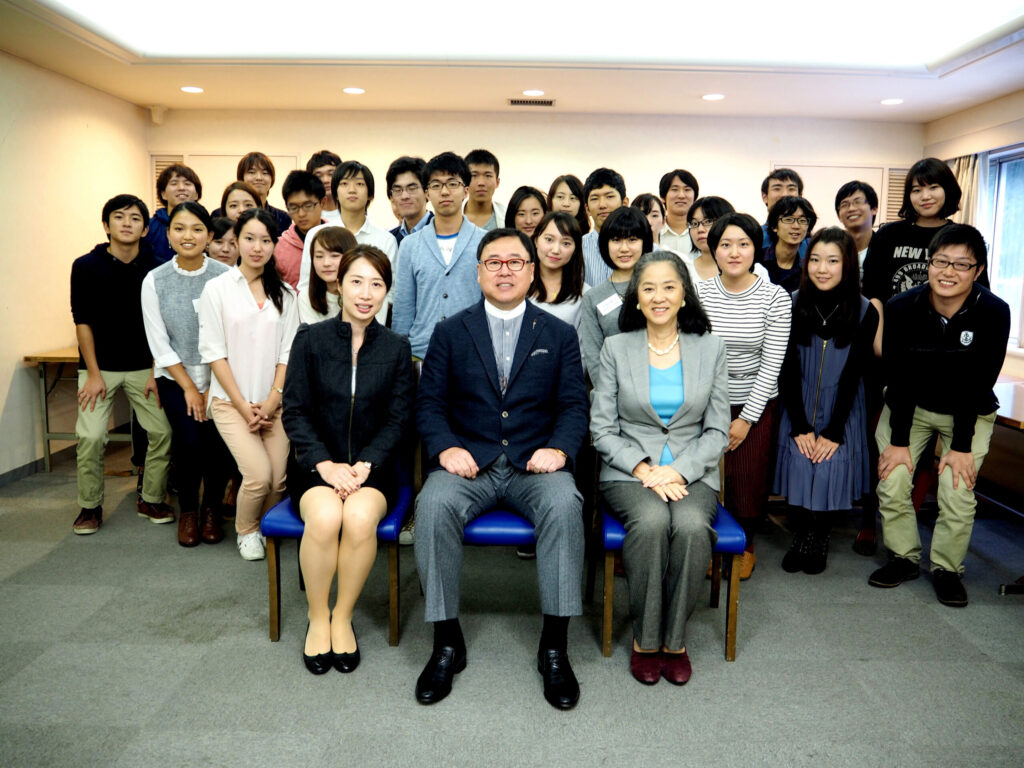
Mr. YANG IN JIP
CEO of Hite-Jinro Japan
September 2015 "Thinking about Japan, China and Korea 70 years after the war(cont.)"
The third Special Seminar Forum was held this month. Continuing from June and July, we invited Mr. Hirofumi Wakamiya, Senior Fellow at the Japan Center for International Exchange, former Chief Editorial Writer of The Asahi Shimbun, and later Visiting Professor at universities in Japan and South Korea, to discuss the current state and future prospects of international relations among Japan, China, and South Korea, as well as the United States.
Seventy years after the end of World War II, the political landscape of East Asia and the world is undergoing major changes. With the passage of the security-related legislation in Japan, it is time to reexamine our relationships with neighboring countries and allied nations. In preparation for this forum, participants were divided into groups representing Japan, South Korea, China, and the United States, and conducted three weeks of preliminary research before engaging in debates while role-playing as national leaders or cabinet ministers.
On the day of the forum, participants engaged in a role-playing debate in which they expressed positions from each country’s perspective on issues such as the Abe Statement and the anti-Japan military parade, followed by simulated summit meetings. The Abe Statement sparked considerable debate domestically and internationally. However, by critically examining it from multiple national perspectives, we came to recognize how carefully and politically crafted it was—balancing compromise and assertion while taking into consideration many different audiences.
During the simulated summit discussions, the debate became highly sophisticated as participants presented their arguments while recognizing one another’s strengths and weaknesses. We gained first-hand experience of the difficulties of diplomacy, which requires taking into account diverse factors such as economics, religion, human rights issues, and military considerations.
By researching information and devising strategies for each country, KIP members gained a deeper understanding of national intentions and current circumstances. For us as young people, this seminar forum was extremely valuable in thinking about Japan’s current position in the world and the direction the country should take in the future.
July 2015 "Thinking about Japan, China and Korea 70 years after the war"
We invited Mr. Hirofumi Wakamiya—Senior Fellow at the Japan Center for International Exchange, former Chief Editorial Writer of The Asahi Shimbun, and later visiting professor at universities in Japan and Korea—to deliver a lecture. As Japan marks the 70th year since the end of World War II and debates on historical recognition have resurfaced among Japan, China, and South Korea, this forum focused on the Abe Statement and the Yasukuni Shrine issue.
In the first half of the session, Mr. Wakamiya provided an overview of the history of Japan’s domestic and foreign policy from the wartime period to today. He explained how politicians such as Tanzan Ishibashi, who sought to build friendly relations with China and the Soviet Union; Nobusuke Kishi, who placed greater emphasis on ties with the United States; and Kakuei Tanaka, who again approached China and realized the normalization of diplomatic relations, shaped Japan’s diplomacy while balancing relations among Asia and the U.S. He also discussed the diplomatic significance of the Murayama Statement—which offered a formal apology for the sacrifices caused by the war—its role in modern times, the outlook of the Abe Statement, and future relations with Asia. Through this, we were able to learn about ongoing diplomatic issues from a historical perspective.
The second half of the session featured group discussions based on the lecture. Participants were asked to consider what kind of statement they would issue if they were prime minister, and whether they would visit the Yasukuni Shrine. A central point of contention in both topics was whether to prioritize international relations, or domestic nationalism and respect for the war dead. Although the axis of the debate was relatively clear, we felt firsthand the difficulty of reaching mutual agreement on issues where past history, diplomatic relations, economic factors, and more intertwine in complex ways. Historical issues are delicate matters strongly tied to nationalism, with many points that neither side can easily concede. Finding compromises will likely remain a major challenge going forward.
June 2015 "Economics of Orchestra and Japan’s Cultural Power"
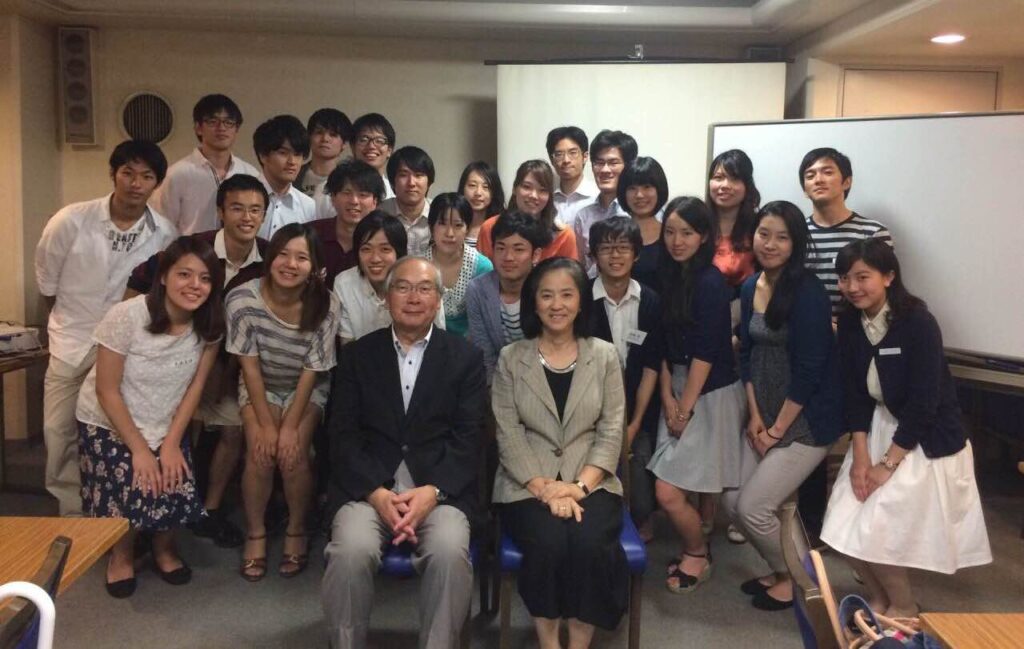
Mr. Tamio Kanou
Former General Director of NHK Symphony Orchestra
We invited Mr. Tamio Kanou, a former general director of NHK Symphony Orchestra as our guest speaker. His quizzes on the origin of the word “orchestra” and the origin of orchestra helped to increase my understanding of the subject. I also learned about the librarians who cut out a sheet of music so that it can be easily read by performers and the attenders who are assistants to conductors or soloists. These people don’t perform on stages themselves. However, without their support, the orchestra will not be able to present their concerts and audiences will not be able to hear their performance. Although I have been to orchestral concerts several times, I have never realized this.
I have always guessed that the main source of orchestra’s annual revenue was performance income. However, I learned that the amount of subsidies from the government and a donation from companies were more than that of actual performance income. After Mr. Kanou’s lecture, we had a discussion on whether the Japanese government should subsidize an orchestra. I supported for the subsidies because I remembered enjoying listening to an orchestral concert in a nice dress when I was little. I wanted other children to have the same opportunity. However, others questioned whether the preservation of orchestra was necessary because unlike kabuki and gagaku, an orchestra is not traditional to Japanese culture. I wasn’t able to come up with a persuasive counterargument. I fully realized the delicate position of an orchestra.
May 2015 "The Internet: Friend or Foe?"
Speech summary
At first Mr.natsume and the alumnus discussed the present situation and problems on working environment of foreign workers. Now Japan accepts many foreign workers who want to work in the industries which face serious lack of people. However, according to Mr.Natsume’s speech, their working environment is often terrible. For example, they are forced to work overtime at extremely low salary, and they even cannot take family along to Japan. The government takes some measures, but it’s still insufficient because of the lack of budget and people who relate to the measure, so he said we have to prepare the efficient system, such as counselors who are foreign people living in Japan, rapidly.
Secondly, he told us about the outline of a work style reform law and its issue. This law is composed from mainly 4 part: the overtime cap, taking a paid holiday, equal pay for equal work, and advanced professional system. However, the overtime cap is just same as the line of karoshi, so this can lead to the situation that companies justify overtime work within that line. Also, small to medium-sized companies are not so willing to change their working styles, so it seems that we need to revise this law with many loopholes. In addition to this, Mr.Natsume questioned the Japanese government’s stance that they are trying to expand the gap among different-workstyle-people, while many countries are making it goal to eliminate the gap.
Discussion
The theme of the discussion was ‘The work style reform law really leads to economic promotion of Japan?’ In my group, our stance was ‘yes’ and discussed a lot about problems which may arise because of this law and how to solve those problems.
In floor discussion, there were mainly two groups: one agreed with this idea, because they thought employees could improve their skills during their free time or the work efficiency would improve, while the another one disagreed, because they thought this law made no difference in women and elderly people’s participation. Especially we had different opinion on the topic, ‘The overtime cap truly bring about improvement in work efficiency?’ and discussed actively asking a lot of questions each other.
In the last part, Mr.Natsume commented on our discussion and said like this: the present law has a lot of loopholes, so it may be difficult to improve Japanese economy. However, we can expect the improvement in companies all over the country if we revise the law and make the better one. He hopes that fair competition based on fair rules will realize in the future.
Lastly, we want to thank Mr.Ichiro Natsume, who talked us a lot based on his experience during his busy time and the senior member, who interviewed Mr.Natsume and promoted the discussion with great sincerity.
(Yuna Watanabe, College of Arts and Sciences, The University of Tokyo)
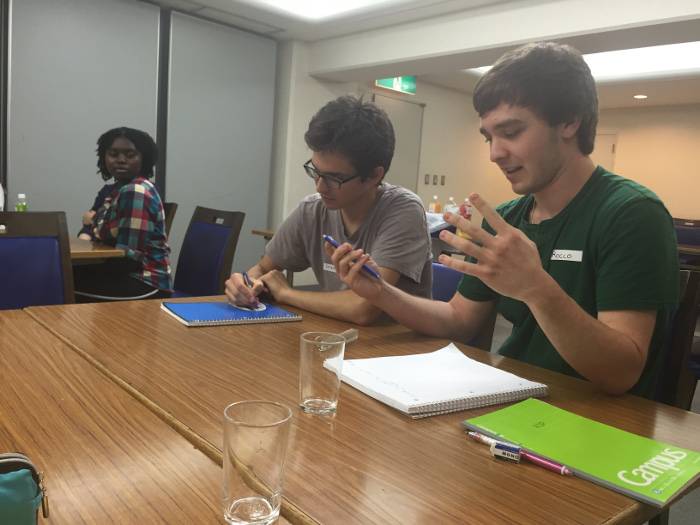
Mr. Ian de Stains
Executive Director of TELL
April 2015 "How the world would become? What should Japan do?"
For our April forum, we invited Mr. Hatsuhisa Takahashi, a former NHK commentary chairperson who is now the chief director of The Tokyo Club as our guest speaker. He also used to be the director-general for press and public diplomacy in the ministry of foreign affairs of Japan. He gave us a talk on today’s international issues, such as the conflicts in the Middle East, underlying reasons of the expansion of IS, and the relationship between media and societies.
As for the relationship between media and societies, Mr. Takahashi stressed that the form of international terrorism has dramatically changed because of the development of the Internet. For example, pictures, which had to be broadcasted through a TV station, can be broadcasted by anyone today making the information control extremely difficult.
Then we discussed “What Japan can do against international terrorism.” It was meaningful in that we exchanged opinions about the definition of international terrorism and international contribution from martial and economic aspects. (Translated by Daisuke Mizutani)
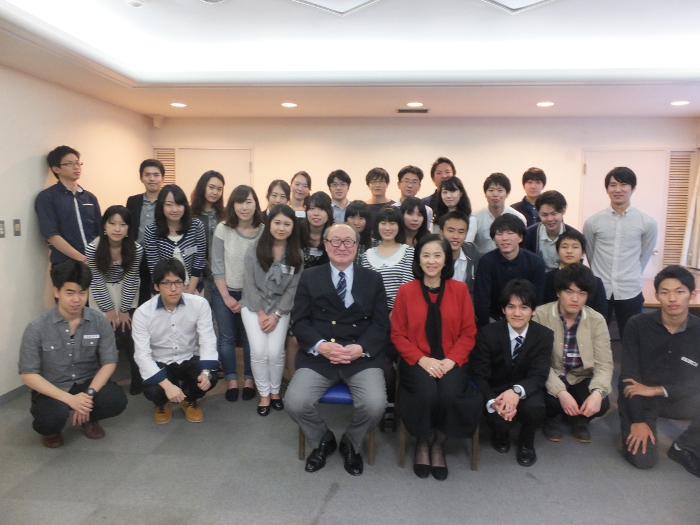
Mr. Hatsuhisa Takahashi
Former NHK commentary chairperson, who is now the chief director of The Tokyo Club.