


Februrary 2018 “The museum in the 21st century: Who is it for and Why does it matter?”
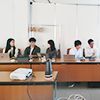
For our February forum, we invited Ms. Roisin Inglesby, who is the curator at the Tokyo Metropolitan Teien Museum. The title of the speech was “The museum in the 21st century: Who is it for and Why does it matter?” As the curator, she talked about the role of the museum and how it should be. Based on her lecture, we discussed the theme of “Should museums be free of charge?”
This forum fell into two parts. First part was about the speech of Ms. Roisin Inglesby and Q&A session about her speech. There were four topics in her speech “Who do history and culture belong to?”, “What kind of things should be exhibited in museums?”, “Who goes to museums?”, “Where should the money come from?”. Second half had the discussion whose title is “Should museums be free of charge?”. In this session, students discussed this issue.
Her speech started about the history of arts which were owned as private collections. In 1683, first museum opened in Oxford University, named Ashmolean Museum. In a few centuries, lots of museums have been established. Yet the arts have opened to the public, some issues didn’t disappear, because there were the problems of returning cultural properties. Large amount of exhibition came from the other place by looting or importing, so it’s hard to determine ownership. Furthermore, she talked about the critical cultural properties in the countries of under wartime like Syria, Egypt and Afghanistan. They sometimes lack of facilities to keep them safely and they have to choose whether to evacuate them outside the county or leave it to local people. We need to rethink about this ownership problem.
Secondly, she talked about exhibitions of museums. Not only the luxury arts or sculptures, but the commodities, like Hallo Kitty’s goods and Starbucks’ tumbler, also have a value of symbolizing our consumer culture. She told us that museums need to collect more various exhibits to provide opportunities to think about our society.
In the third topic, she talked about the people who visit museums and how to tell them the good points of museums. These days, museums try to make explanations for kids or allow photography in order to attract more people. Sometimes, museums improve the quality of exhibits and curator’s skills. Furthermore. museums started holding party and event at their museum building. Owing to their effort, the number of visitors is increasing in the UK.
Finally, she taught us about money problem, who should pay for and where it comes from. Museums have three sources of entrance fee, tax and donation. First problem is the relation between entrance fee and tax. Whether we recognize museums as public facilities like library or luxury facilities like movie cinema, significance of entrance fee will change. In the UK, more and more museums introduced free charge based to the former idea. Secondly big problem is donation from company like oil company. They usually try to restrict exhibitions in order to hide unfavorable things for their business. From the academic and public viewpoints it brings a big loss to our society. Therefore, museums in the UK try to eliminate such a dirty money to make pure and sustainable culture and historical place.
Based on her lecture, we discussed “Should museums be free of charge?” In case of normal exhibitions, from the view of public and their ownership, some agreed with free charge. On the other hand, from the view of sustainability and its aspects of luxury, others disagreed with the idea. In case of special exhibitions, most of us disagreed with free charge and the people who want to see the exhibits should pay money, because the term of special exhibitions and visitors are limited, and exhibitions requires large amount of expense such as transportation and personnel.
This was first KIP forum with art as a theme and we had a great opportunity to learn and think what the museums are.
We are very grateful to Ms. Inglesby for this interesting lecture and discussion.
(Yutaro Shindo)
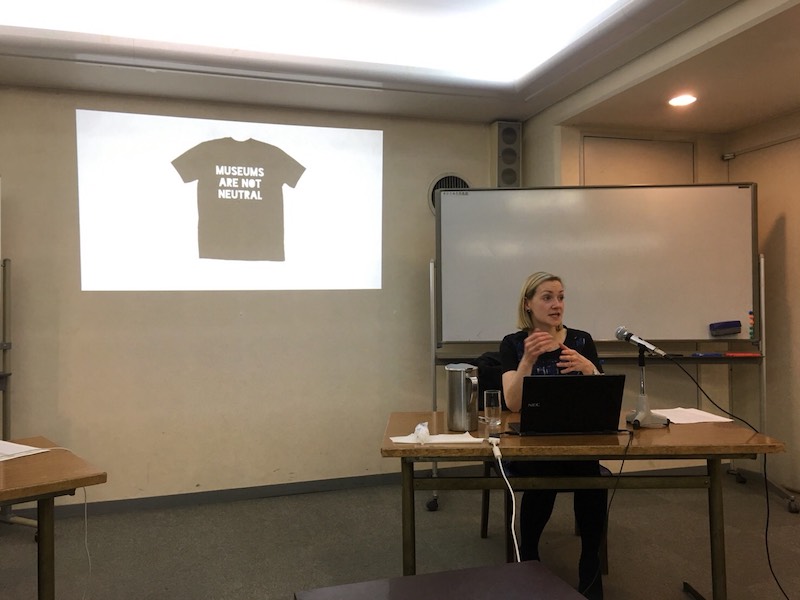
Ms. Roisin Inglesby
A museum curator and independent scholar. She has a BA from the University of Oxford and an MA from the Bard Graduate Center, New York, where she studied the History of Design. She worked at the Victoria & Albert Museum in London for 5 years before joining Historic Royal Palaces as Curator of Drawings, based at the Tower of London. Since moving to Japan she works part time at the Tokyo Metropolitan Teien Museum in Meguro.
January 2018 "How do you guys live in a global era? ~the significance of working for international organization~"
January forum was held and we invited Mr. Shigeo Kashiwagi who was a director of the International Monetary Fund and now teaches at the Graduate School of Commerce, Keio University. The title of the lecture was “How do you guys live in a global era? – the significance of working in international organizations-” As the world is getting globalized, he gave us a lecture based on his experience about working in international organizations, the challenges imposed on us in the future, and the abilities necessary for young people to survive the competitive society.
Mr. Kashiwagi divided the lecture into three major points. First of all, he explained what kind of situation the globalization is. Mr. Kashiwagi says that Globalization is a situation that crosses national borders, money, services, people and information. At the same time, there are things such as regulation, administration, national sovereignty that cannot cross the border. Moreover, this movement will become more and more serious in the future. And when the market is no longer limited to domestic today, he pointed out that the rise of monopoly might make the world more competitive. If a country may fall from that competition, the income gap will widen and domestic conflicts will become serious. Looking at the current major national GDP, Japan has been flat for these 20 years. If this situation continues, Japan may not only be separated to the United States and China but also be overtaken by emerging countries.
Next, he spoke about how to work in the global era. Currently globalization is progressing. At the same time, it has entered an era of rapid change, it is said that the most of the current work will be out of the future and the majority of future works will not exist at present. Although it is likely to be linked with working overseas when you think about the global society, it is also possible to increase the work of foreign bosses, subordinates and business partners in Japan and also to be able to conduct global activities even in Japan. We have to change the way of thinking. Also, based on his experience working at international organizations, he explained the attractiveness and necessity of working in international organizations. It is not an easy task, but the size of the scale as well as the sense of fulfillment are remarkably different from other job. Also it is one of attractiveness, the ability to work equally with diverse. As well, there are necessities, to have special field, communication skills, to diversity, Flexibility, and always having my own thoughts.
Finally, he told the importance of knowing yourself, as an advice to us to survive the global era. It is important to have your own opinion and to acquire the ability to convey myself. In order to know yourself, it is necessary to face other people and different way of thinking. Diversity is important in that you get out of common sense and preconceived concepts that you had until now and lead to new ideas. Though I have been concerned that the people in world would become cold to others because of competition in the world as it is mentioned, I sympathized with the fact that it is said that the development of the economies in one country would have a positive impact on the economy of other countries.
After the speech, we had a discussion, “Is it good for Japanese people to work in international organizations?(especially for people who want to contribute the world)”. Some said that certain information helpful for us is only acquired in such places. Others said that they have difficulty to do actual actions because they have to do so many discussions and negotiations, these can be a barrier for people who would like to take actions actively. In that meaning, producing something necessary cannot be achieved by such organizations, so there are some members who want to work in companies and help the world. But basically, we are on the side working in global organizations is good for such people.
In this forum, we understood the real meaning of “globalization” and what we, young people, should do. Thank you for your great speech again!.
(Riho Ishii)
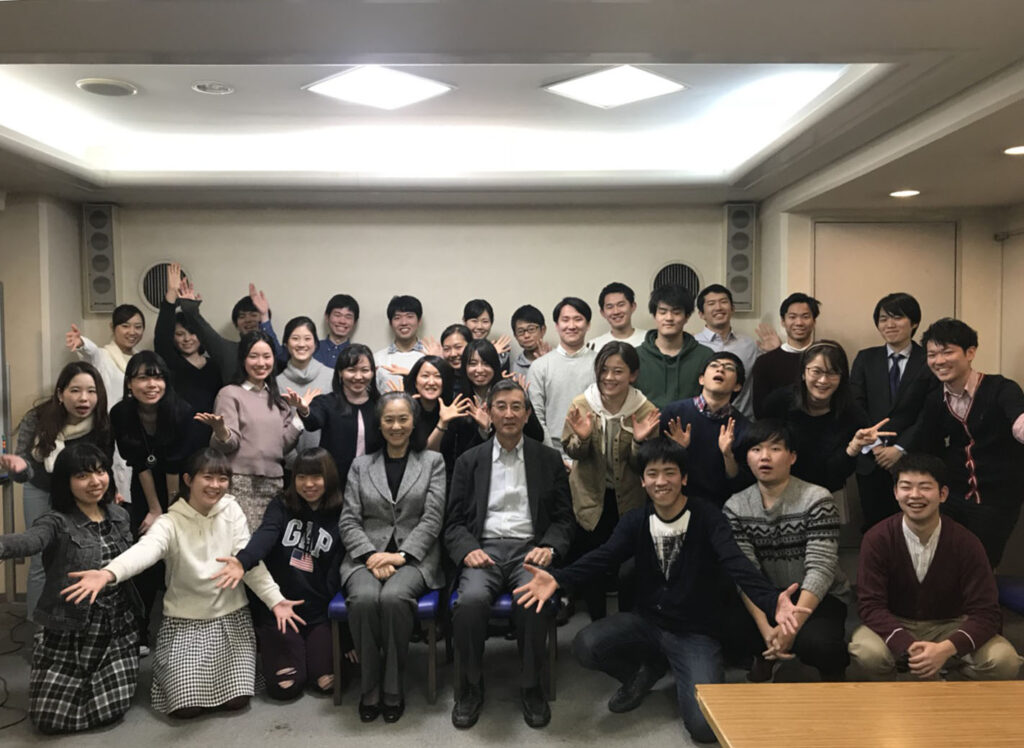
Mr. Shigeo Kashiwagi
After graduating from Keio University School of Economics in 1973, he entered the Ministry of Finance. In 1977, he acquired MPA (Public / International Relations) at Princeton University. In 1993, he was the Director of the International Organizations Division at the Ministry of Finance, and in 1994 he moved to Director of the Asian Development Bank. In 2000 he was a senior adviser to the International Monetary Fund Policy Planning and Examination Bureau, and in 2004 he took over as the International Monetary Fund Director. In 2007 he became a professor at the Graduate School of Business and Commerce, Keio University and became a specially invited professor in 2016.
November 2017 “President Trump and Mass media: Reporting in the post truth era”
As our Ocotber Forum we invited Mr. Kazuo Abiko, who is the former manager of northeast Asia of the Associated Press.The title of the lecture was “President Trump and Mass media: Reporting in the post truth era,” and he talked about the current situation and whereabouts of mass media in America, and comparison between American and Japanese journalism.
As IT develops, the way people communicate in this world is changing such as utilizing social network in order to communicate with people by American President. Today Mr. Abiko had a lecture for us about current and future media situation in America, and difference between Japanese and American journalism.
At first, he made an emphasis on possessing intellectual curiosity. In this generation, people can gain much information from anywhere else, so he implies that people cannot accept all the information in front of them. We must always be skeptical about the information, and figure out what is hiding from the information, and what is the background. Moreover, searching other media is also important in order to get accurate information.
Moving on to the core topic. How Donald Trump won the election utilizing media? News about his stories occupied 50 % of media at that time. This is one of the reasons. This circumstance occurred because his straight words were picked up in the news, and it became entertain. There is a complete formula enable Trump to appear in media widely.
In terms of history of media, radio used to be a major media connecting politician and citizens, and TV replaced, and then, currently, social network is replacing gradually. Those politicians who use social network as a tool make targets who are not “elites” layer, instead, lower class layer than average. This is because the number is big, and they do not read newspaper nor watch TV, so main way they can get political idea is social network, thus politician can easily seize their heart.
Furthermore, Mr. Abiko explained the current American Media. America regards freedom of report as one of the most important rights to be protected. Therefore when Donald Trump tried to sue Newspaper Company for defamation, his proposal was rejected. If someone wants their suit to be accepted, they need to prove the newspaper company did report news, which they have known it was not true. However when Donald Trump sued, it affected citizens’ reliability to Newspaper Company. On the other hand Donald Trump won citizen’s reliability. And when presidents lost their trust, people would trust media. Thus, there is a correlation between two.
Finally, we learned how different between digitalization of Japanese and American media. “New York Times” is one of the most representative media companies in the United States, but New York Times aim to become not only American represent, but World represent. This company’s consumer targets are “elite in the world”. This is why they promote digitalization positively, and spread part of their services for free. On the other hand, digitalization of Japanese newspaper has not been seen so often, also fee is not cheap. Newspaper companies and advertisement companies protect each other would be one of the backgrounds. It seems hard to achieve Digitalization in Japan.
Through this lecture, students discuss the theme “Is it acceptable for president utilizing social network as personal way?” Students argued the pros and the cons. Those in favor insisted, “Even though they are president, they are still one person, and have right to express their idea,”etc. On the other hand, those who opposed insisted, “President’s opinion should be monitored by others, but social network unable others to do it” or “It is possible that president’s personal opinion would affect diplomatic relationship,”etc.
After the discussion, Mr. Abiko said that a president needs to make ambiguous line between “public” and “private” clear. We could learn not only the current media situation, but also the meaning of media, and how important to have intellectual curiosity in this generation.
I would like to say thank you to Mr. Abiko who had a wonderful and worthy lecture for us. Thank you very much.
(Asuka Akazawa)
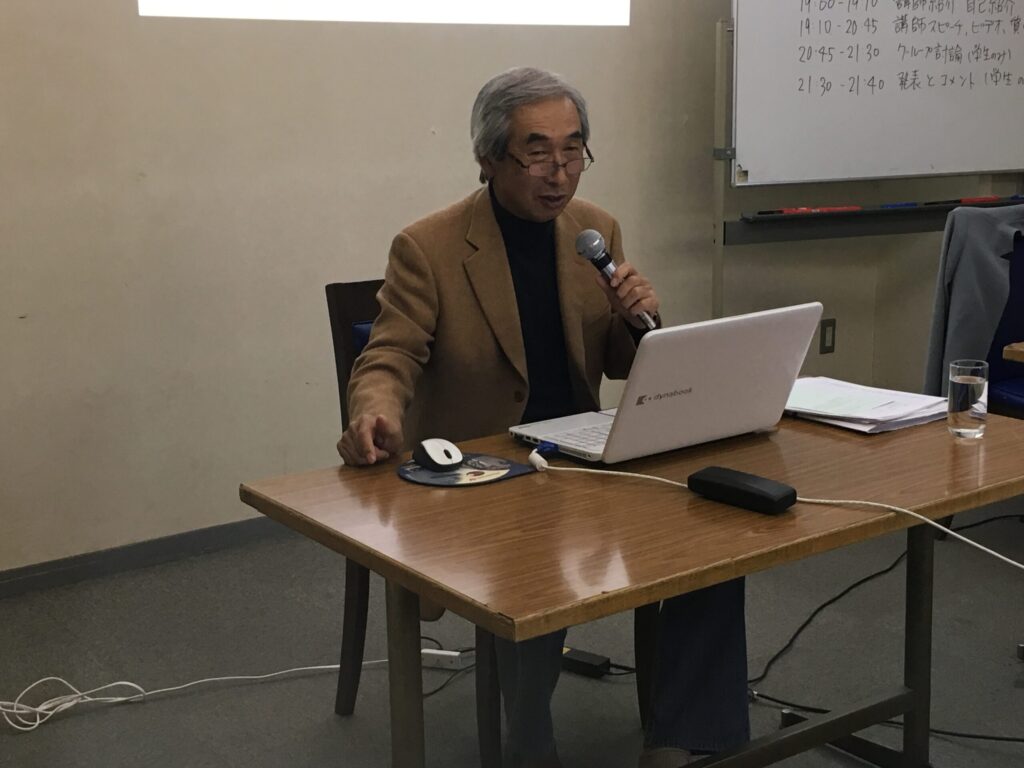
Mr. Kazuo Abiko
He studied journalism in California State University, and studied mass communication in graduate university. He worked for the Associated Press as a manager of northeast Asia, and currently teaches at Global communication Institute in Kanda University of International Studies.
August 2017 “Entrepreneurship and Education”
Mr.Takaki Minamoto
He is an alumnus KIP. He founded M & Associates, a corporation for logistics and trading.
This forum fell into two parts. First part was about the speech of Mr. Takaki Minamoto and Q and A about his speech. Second was about the discussion which title is “The pros and cons of introducing entrepreneurship programs into compulsory education”. In this session, students discussed with this issue.
In his first speech, he talked about the difference between entrepreneur and businessman, examples of entrepreneur, some reasons of why the Silicon Valley is favored by entrepreneurs, and entrepreneurs in education. He spoke about these 4 issues. First, he defined the entrepreneur as a “change maker”. The difference of entrepreneur and the businessman is that the latter one wants to do a business and the former one wants to change something and contribute to his society. The examples of entrepreneur is Bill Gates and Steve Jobs. Bill Gates made a Microsoft and developed IT. Furthermore, thanks to his development, anyone can get the information and send it regardless of their status. For example, in caste system in India, people can approach this system easily regardless of their rank. Also, Steve Jobs made a computer into a smaller one. Therefore, people can get the information easily and listen to music regardless of where they are and when it is. That is, entrepreneurs not only do a business but also contribute to their society as a change maker.
These a lot of entrepreneurs prefer Silicon Valley. The reason of this preference is that the percentage of failing in business is very low there because this place has a lot of resources of business. Also, they have interest in education. In the past, they try to develop the field of IT, but now education is favored by them as a blue ocean. The reason is that old and rich people prefer to invest and spend a lot of money on real estate, journey, and the field of education. He mentioned that the example of entrepreneur in education system is “Teach for America”. The purpose of this program is solving the unfairness of education from economic inequality. In this program, students who graduate from prestigious universities like Ivy League, support the education system for lower-income group. These examples contribute to American society a lot. However, people who have the nationality of each country have advantages in succeeding in business as an entrepreneurs in the country because each country has own education system.
The second part of the forum is about discussion which title is “The pros and cons of introducing entrepreneurship programs into compulsory education”. In this discussion, the concept of entrepreneurship education was divided into improving psychological factors and practical skills. First, we defined psychological factor as challenge spirit to various experiences and defined practical skills as the ones required to be an entrepreneur. The advantage of introducing entrepreneurship programs into compulsory education is that this system can make many entrepreneurs in each country so economic power of each country will become larger. Also, students can become more independent. Contrary to these advantages, weakness of institutionalizing this system is unrealistic. The last evaluation of this discussion was that entrepreneurship education can promote the independence and receptive capacity of various opinions because entrepreneurs have to challenge something on their own and accept various opinions with a wide view. That is, these factors can help the progress of each country.
Through this forum, I felt the importance of education and the real meaning of entrepreneurship: Practical skills for entrepreneur and receptive capacity of various visions.
(Kie Kang)
June 2017 “Trump regime and Situation in East Asia”
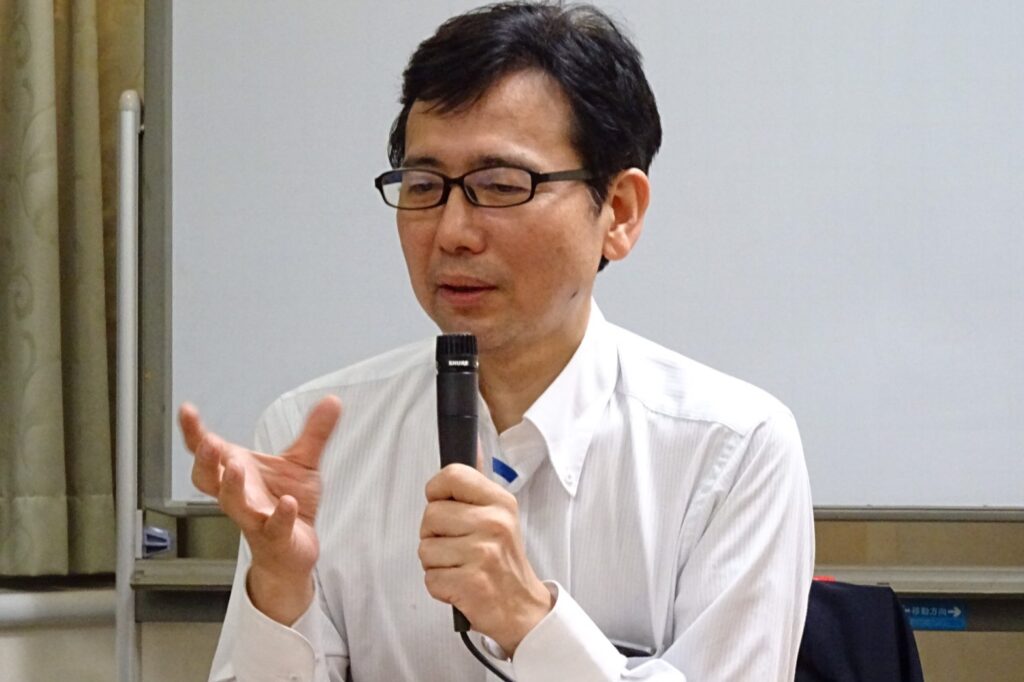
Mr. Noriyuki Shikata
After graduating from Kyoto University faculty of law and Harvard Kennedy School, Mr. Noriyuki Shikata entered the Ministry of Foreign Affairs in 1986. He is one of the directors of KIP, and after wroked at Ministry of Foreign Affairs of the Asia Pacific Bureau, now he works for People’s Republic of China Embassy of Japan.
For our June forum, we invited Mr. Toshiyuki Shikata, who is the director of KIP, as our speaker. He has been Ministry of Foreign Affairs of the Asia Pacific Bureau. The title of his lecture was “Trump regime and Situation in East Asia”
At first, Mr. Shikata told us Japan-China relations, Taiwan, Korean situation, Japan-US relations. He gave us the lecture in the relationship between Japan and China, through the contents of the Japan-China summit held in September last year, we learned about five areas of cooperation and three common issues. Even though relationship of the two countries sometimes become strained because of foreign affairs like the problem in East China Sea, I realized that Japan and China are economically important partners, and there are many exchanges of people between the two countries, so they have similar problems. I was impressed by his words that it is important how to manage his troubles of international relations. Also, we were able to know about current situation of China like One Belt, One Road and AIIB, which were themes of discussion.
Then, he taught us Japan-US relations, Abe and President Trump are currently intimate, especially working together on North Korea issues. In addition, Ms. Yamamoto who is Assistant to the Ministry of Foreign Affairs Asia Pacific Bureau at that time also told us about Asia framework centered on ASEAN, challenges of each country and relations with Japan. Furthermore, we learned from her what kinds of policy have been taken to make diplomacy successful with foreign countries which have different cultures and languages.
〈Q&A〉
Q1 Why are China’s economic sanctions against North Korea inadequate, in contrast to Japan and the US preparing sanctions?
A1 China is concerned that North Korea will collapse and many refugees will come to China. China wants to have a dialogue between the US and North Korea.
Q2 What is the common philosophy of ASEAN that was in the lecture of Ms. Yamamoto?
A2 Japan is promoting the protection of freedom, democracy and human rights. And Japan is supporting in line with their philosophy.
〈Discussion〉
After that, we had a group discussion on “Should Japan participate in One Belt and One Road?”. The conclusions of discussion by each group were considerably diversified, and there was a difference even in the group who said yes in terms of how to participate. There were opinions in groups which think Japan should participate in it that Japan would be isolated if we didn’t, we could cooperate with China for how to treat North Korea, and competitive involvement is necessary to expand the market. There were opinions of groups who said that it should not be involved, coordination with China has a danger of harming relations with the US, it’s more important to cherish the current framework, and political philosophies of both countries are too much different, and so on. After presentations of each group, Mr. Shikata gave us comments that when we think about these issues, we should consider what matters for Japan(purpose) and how Japan should take actions (measures).
Finally, I would like to express our gratitude to Mr. Shikata and Ms. Yamamoto for taking time to speak to us.
(Kaori Kurabayashi)
May 2017 “To maintain wealth in aging, declining birth rates and population decline What to be able to do by youth”
For our May forum, we invited Mr. Toshiro Nishizawa who teaches at The Graduate School of Public Policy, University of Tokyo. Mr. Nishizawa used his own briefing paper that was used when he visited Lee Kuan Yew School of Public Policy, National University of Singapor and Korea Eximbank for forum`s contents. In his lecture, he refers to big change “to maintain wealth in aging, declining birth rates and population decline” seen in Japan in terms of what to be able to do by youth.
In this forum, Mr. Nishizawa put much focus on thinking these problems as “our own” problems. However, this forum’s theme is too big and vague for us to discuss directly. Therefore, he started his lecture from two perspectives. The first one is how population decline have influence on GDP growth. The second one is how Japanese government should deal with this problem.
He started the lecture from the former perspective. If Japan`s population decrease because of aging society and declining birth rates, the productivity of Japan will keep descending and we will not be able to maintain the current level of GDP growth rate. It is always true that someone should bear the cost, which is emerged due to this situation. Now in Japan, Mr. Nishizawa pointed out that they were the future generations. He showed the generation gap of pension and traditional employment style as the examples of problems. He also presented some public documents that showed current situation of declining regional power and quoted the word “capacity of connect,” which meant the importance of cooperation of various actors, and “capacity of opening”, which was the mindset to keep themselves open to others.
Secondly, Mr. Nishizawa mentioned how Japanese government had dealt with this situation in terms of financial and monetary policy. There were two goals. The one is sustaining the level of the national income, and the other one is contributing to the financial systems of Asia.
Looking at the current distribution of national income in Japan, households and corporate departments are in surplus, while government and overseas departments are in deficit. Moreover, we realize big changes in terms of the breakdown of the current account balance. Although the current balance has been in surplus, the trade balance is in deficit, and the primary income balance is growing steadily instead. This shows that the support of national income is taking over from the trade surplus to the return of investment abroad. In thinking overseas investment, attractive things in Japan are high-quality infrastructure. For that reason, credits of overseas banks have been active in Japan. Based on this background, Mr. Nishizawa said that if we looked at the recent policy of Japan, we could see the characteristic movements in the Financial Services Agency. A long time ago, few people thought this kinds of attitude to pay attention to the mutual relationship between banks and their customers.
Based on these contents above, we discussed the theme ” Should Japan abolish retirement system?” In the discussion, many group focused on maintaining economic wealth. And the opinions of each group were mainly that since Japan’s domestic labor force will decline in the future, the retirement system should be ensured to secure the labor force and that we should abolish the retirement system and maintain labor force by accepting workers from abroad.
Several opinions were showed by the group proposing continuation of the retirement system. Someone mentioned that we could pass on the technology transfer to young people by arranging workers with abundant experience optimally. Some students were anxious about accepting immigrants in view of the difficulties in handling migrant workers.
On the other hand, students who supported abolishing the retirement system claimed that it was beneficial for Japan to use more foreign workers because it would make Japanese working environment more diverse, and that under competent workers could not perform well under Japanese traditional employment system. Various opinions were also observed, such as raising the age of retirement instead of abolishing it.
After finishing the discussion, we got a message to confirm the spirit of the lecture from Ms. Packard. Although we tend to recognize that problems in everyday life are various and separated, the fundamentals of those situations are widely connected across national borders. In order to understand the situation deeply, it would be necessary to act actively with interest, taking advantage of being students. I comprehended the importance of maintaining the attitude of not only staying at a comfortable place but taking action positively.
(Soichiro Sasaki)
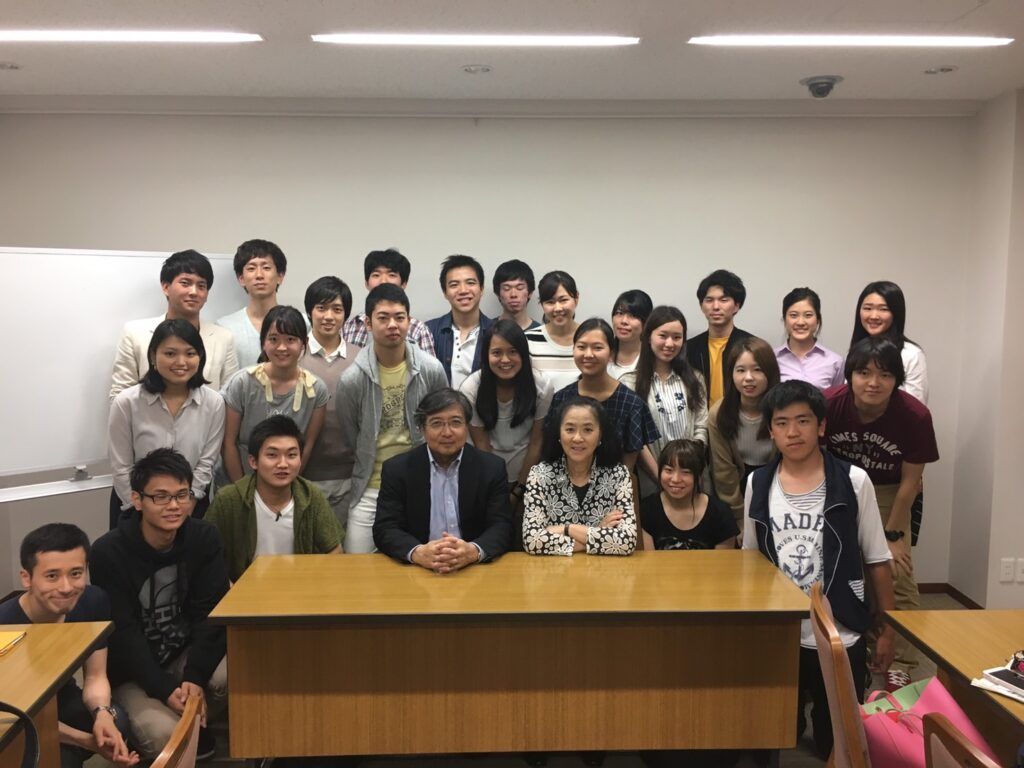
Mr. Toshiro Nishizawa
After graduating from Tokyo University of Foreign Studies and the University of Tokyo, Mr. Nishizawa entered Japan Bank for International Cooperation. After that, he also served Ministry of Finance, Ministry of Foreign Affairs of Japan, International Monetary Fund, Japan Finance Corporation, Japan Center of International Finance, International Bank for Reconstruction and Development. And He became a Project Professor at the Graduate School of Public Policy(GraSPP) of the University of Tokyo from 2015.
April 2017 “President Trump and how would Japan deal with him”
On the evening of April 28th we had a lecture and Q&A session about the United States presidential election in 2016, Donald Trump’s Policies so far, and how Japanese government would deal with him. The speaker, Mr. Ichiro Fujisaki served as an ambassador to United States in 2010 and is currently the president of the Japan-America Society and a professor concerned with international strategy in Sophia University.
In the first half, Mr. Fujisaki gave us the presentation on the United States presidential election in 2016 and Donald Trump’s Policies so far, and then he talked about how Japanese government would deal with him. When Trump won the election, most Japanese media reported his victory as if it was inevitable and the turning point of the US history. However, at the beginning of his presentation, Mr.Fujisaki pointed out that it was a very close election. He also mentioned that Trump won Pennsylvania, Michigan and Wisconsin by a very narrow margin and Hillary Clinton’s email scandal caused just before the voting day. Therefore, it is difficult to reason that most people in the United States welcomed Trump, so he won the election. And then, Mr. Fujisaki emphasized the importance of analyzing information and thinking about it by oneself. This speech was the most impressive part for me in his presentation. After that, we started Q&A session. One student asked how he thought about the Philippines’ diplomacy. Other student questioned about his experiences as an ambassador in United States. He answered them very clearly and honestly.
In the latter half, we had a group discussion on “Is it justifiable for US to intervene in North Korea proactively?”. In my group, we partly agreed with the US’s intervention in North Korea in recent. However, we thought US should apply less economic sanctions against North Korea. That’s because more economic sanctions would impoverish people in the country and that would make Korean reunification more difficult. After each group’s presentation, Mr. Fujisaki made a general comment. He pointed out that if we stop or reduce the restriction on North Korea and its economy recovered, we will have to be more worried that it invests more money to the military weapons. He also suggested that China is the key country to solve this problem. He said that Japan and United States had to persuade China to restrict North Korea trade. Finally, I would like to express our gratitude to Mr. Fujisaki for taking time to speak to us.
(Takashi Seto)
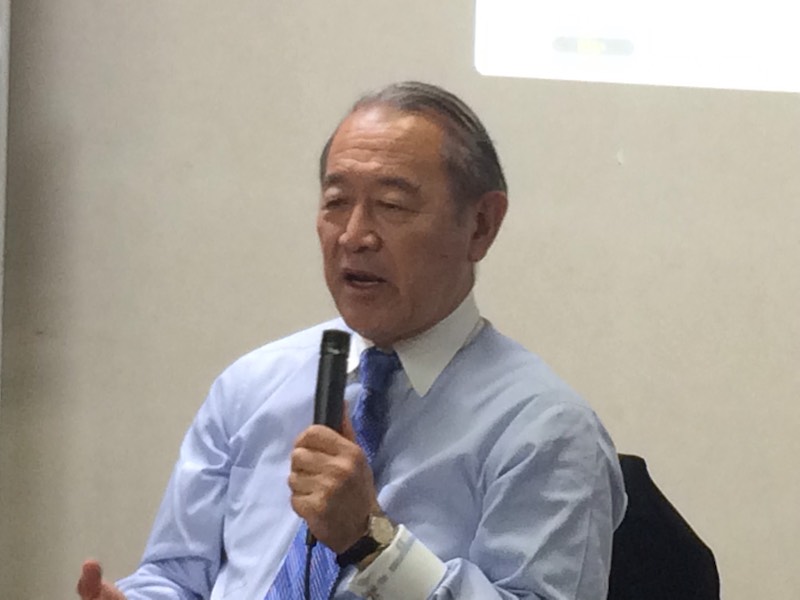
Mr. Ichiro Fujisaki
Mr. Ichiro Fujisaki served as Ambassador to the US. Now he holds positions such as President of The America-Japan Society and Visiting Professor Sophia University.